
2011-11-30 "Bilal Ali, Co-founder of Occupy the 'Hood, Beaten and Detained" by Kwazi Nkrumah I have just gotten information over the past couple of hours that Bilal Ali, co-founder of Occupy the 'Hood Los Angeles, was apparently beaten and detained by LAPD officers in last night's actions.
According to several people who have contacted me, Bilal and Joseph Thomas were kettled away from a larger group of Occupy supporters near Pershing Square sometime between 2:30 and 3:00 a.m. and were beaten repeatedly by LAPD officers with battons. Bilal appeared to be injured, perhaps seriously.
Bilal is a very well-known organizer and advocate for tenants, workers and the homeless in downtown L.A., especially over the past 8-10 years. In particular Bilal has figured prominently in a series of major conflicts with the Central City Association over questions of their influence over the City Council and other public institutions, including the police. It is this same association that has been working behind the scenes to get Occupy L.A. evicted and to get the City Council to enact a special ordinance to prohibit the use of City Hall as a platform for public protests.
In June of last year, Bilal and approximately 20 others were physically assaulted by police INSIDE City Council chambers following a public hearing on extending a rent freeze for tenants throughout the city that attracted the largest turnout of tenants in the history of Los Angeles. Legal action later led to financial compensation for the victims of this attack, and a judicial reprimand of City Hall police for the use of excessive force against peaceful protesters. Since that time, Bilal has been the target of numerous incidents of police harrassment, including being unlawfully detained outside his apartment building twice last summer. He has several complaints filed through the police commission related to these incidents.
Occupy the 'Hood calls upon ALL Occupy Movement activists, ALL friends and supporters of Occupy the 'Hood, and ALL progressive people in general to support Bilal Ali and ALL those arrested and detained in the police actions against the Occupy Movement last night and this morning. We are concerned with Bilal's present physical condition, in particular. We believe he is being held at the Parker Center holding facility. No charges have as yet been filed against him that we know of.
We call for your support, and will post more information as soon as we get it.
Build the Occupy Movement!!!
Organize the 99%!!!
Free All Our Occupy Movement Detainees Now!!!
Wednesday, November 30, 2011


2011-11-30 "The Occupy Education Protests Are Working"
[http://www.occupyed.org/2011/11/30/the-occupy-education-protests-are-working/]
[occupyeducationca@gmail.com]
---
The protests are working. Mass strikes, rallies, and encampments on college campuses in California and beyond in the past weeks have put the defense of public education at the center of the national spotlight and have already forced the authorities to make numerous concessions. Here are some of the most important developments:
1) The White House has been forced by the protests to respond. The New York Times reports [http://www.nytimes.com/2011/11/30/education/duncan-calls-for-urgency-in-lowering-college-costs.html?_r=2&hpw]: “As Occupy movement protests helped push spiraling college costs into the national spotlight, Education Secretary Arne Duncan urged higher-education officials Tuesday to ‘think more creatively — and with much greater urgency’ about ways to contain costs and reduce student debt.”
2) The proposal to raise UC tuition up to 81% was dropped (for now) by UC President Marc Yudof [http://articles.latimes.com/2011/nov/09/local/la-me-uc-20111109], in response to the growing education movement. Yudof is now calling for $412 million more state funding for higher education. Various prominent politicians, such as Kevin De Leon and Gavin Newsom, are also now saying they support funding education through taxing the rich and corporations.
3) The outcry against the police violence inflicted on students at UC Davis and UC Berkeley, has forced the authorities and police onto the defensive. Both Governor Jerry Brown and UC President Marc Yudof have launched investigations and attempted to distance themselves from the police brutality [http://www.dailycal.org/2011/11/28/campus-academic-senate-passes-resolutions-criticizing-administrations-response-to-occupy-cal/]. Numerous faculty associations have condemned the administrators and police.
We’ve got the 1% on the run, but the struggle is far from over. California schools are facing $1.4 billions in “trigger cuts” this December [http://www.mercurynews.com/breaking-news/ci_19358800]. Promises and rhetoric from the politicians are useless unless concrete actions are taken to reverse the cuts and fee hikes, de-segregate public education, and ensure the prohibition of further police violence.
That is why it is crucial to keep mobilizing until all our demands are met. To win, the movement must expand from undergrad and graduate students to all public education workers, teachers, staff, and their unions. We must build an alliance between higher education and K-12. We must champion the specific demands and struggles of immigrants and communities of color.
And we must build momentum towards our most effective and powerful tactic: a statewide strike of all sectors of public education that lasts until our demands are met. A crucial organizing tool in this direction is the Open Letter to Defend CA Public Education [http://www.change.org/petitions/open-letter-defend-ca-public-education]. Please sign and distribute this widely and get involved now with organizing for the Wave of Action in the Spring.
2011-11-30 "Bilal Ali, Co-founder of Occupy the 'Hood, Beaten and Detained" by Kwazi Nkrumah
I have just gotten information over the past couple of hours that Bilal Ali, co-founder of Occupy the 'Hood Los Angeles, was apparently beaten and detained by LAPD officers in last night's actions.
According to several people who have contacted me, Bilal and Joseph Thomas were kettled away from a larger group of Occupy supporters near Pershing Square sometime between 2:30 and 3:00 a.m. and were beaten repeatedly by LAPD officers with battons. Bilal appeared to be injured, perhaps seriously.
Bilal is a very well-known organizer and advocate for tenants, workers and the homeless in downtown L.A., especially over the past 8-10 years. In particular Bilal has figured prominently in a series of major conflicts with the Central City Association over questions of their influence over the City Council and other public institutions, including the police. It is this same association that has been working behind the scenes to get Occupy L.A. evicted and to get the City Council to enact a special ordinance to prohibit the use of City Hall as a platform for public protests.
In June of last year, Bilal and approximately 20 others were physically assaulted by police INSIDE City Council chambers following a public hearing on extending a rent freeze for tenants throughout the city that attracted the largest turnout of tenants in the history of Los Angeles. Legal action later led to financial compensation for the victims of this attack, and a judicial reprimand of City Hall police for the use of excessive force against peaceful protesters. Since that time, Bilal has been the target of numerous incidents of police harrassment, including being unlawfully detained outside his apartment building twice last summer. He has several complaints filed through the police commission related to these incidents.
Occupy the 'Hood calls upon ALL Occupy Movement activists, ALL friends and supporters of Occupy the 'Hood, and ALL progressive people in general to support Bilal Ali and ALL those arrested and detained in the police actions against the Occupy Movement last night and this morning. We are concerned with Bilal's present physical condition, in particular. We believe he is being held at the Parker Center holding facility. No charges have as yet been filed against him that we know of.
We call for your support, and will post more information as soon as we get it.
Build the Occupy Movement!!!
Organize the 99%!!!
Free All Our Occupy Movement Detainees Now!!!
I have just gotten information over the past couple of hours that Bilal Ali, co-founder of Occupy the 'Hood Los Angeles, was apparently beaten and detained by LAPD officers in last night's actions.
According to several people who have contacted me, Bilal and Joseph Thomas were kettled away from a larger group of Occupy supporters near Pershing Square sometime between 2:30 and 3:00 a.m. and were beaten repeatedly by LAPD officers with battons. Bilal appeared to be injured, perhaps seriously.
Bilal is a very well-known organizer and advocate for tenants, workers and the homeless in downtown L.A., especially over the past 8-10 years. In particular Bilal has figured prominently in a series of major conflicts with the Central City Association over questions of their influence over the City Council and other public institutions, including the police. It is this same association that has been working behind the scenes to get Occupy L.A. evicted and to get the City Council to enact a special ordinance to prohibit the use of City Hall as a platform for public protests.
In June of last year, Bilal and approximately 20 others were physically assaulted by police INSIDE City Council chambers following a public hearing on extending a rent freeze for tenants throughout the city that attracted the largest turnout of tenants in the history of Los Angeles. Legal action later led to financial compensation for the victims of this attack, and a judicial reprimand of City Hall police for the use of excessive force against peaceful protesters. Since that time, Bilal has been the target of numerous incidents of police harrassment, including being unlawfully detained outside his apartment building twice last summer. He has several complaints filed through the police commission related to these incidents.
Occupy the 'Hood calls upon ALL Occupy Movement activists, ALL friends and supporters of Occupy the 'Hood, and ALL progressive people in general to support Bilal Ali and ALL those arrested and detained in the police actions against the Occupy Movement last night and this morning. We are concerned with Bilal's present physical condition, in particular. We believe he is being held at the Parker Center holding facility. No charges have as yet been filed against him that we know of.
We call for your support, and will post more information as soon as we get it.
Build the Occupy Movement!!!
Organize the 99%!!!
Free All Our Occupy Movement Detainees Now!!!
Occupy Eureka attacked by Police
20122-11-30 "Police Escalate Attack on First Amendment Rights at Occupy Eureka"
At approximately 4:00 pm PST in Eureka, CA the Eureka Police Department, in cooperation with the Humboldt County Sheriffs office and the California Highway Patrol, converged on the Occupy Eureka demonstration located in front of the Humboldt County Courthouse and systematically dismantled the protest site, demolishing and confiscating the new Scott Olsen Media Center which was under construction.
Approximately 30 officers detained 15 people (demonstrators and bystanders) in handcuffs and ordered them to sit on the courthouse steps without explanation while the officers confiscated materials both related and unrelated to the protest including signs, banners, supplies, tools, jackets and blankets. Of the 15 detained, two were arrested.
The interim chief of police, Murl Harpham, had assured protesters that no signs or banners would be confiscated, yet all were taken and thrown into the back of a waiting military style, panel sided truck, the same truck used for all previous police raids of the Occupy Eureka demonstration and encampments.
Considering law enforcements’ blatant violation of Eureka city municipal codes and California civil and penal codes, in addition to Constitutional rights, attorneys are interested in filing suit. This is just the latest assault by law enforcement perpetrated on the Occupy Eureka group which endures daily harassment by Eureka police.
[http://codes.lp.findlaw.com/cacode/CIV/5/d1/2/s52.2]
CAL. CIV. CODE § 52.1 : California Code - Section 52.1
(a)If a person or persons, whether or not acting under color of law, interferes by threats, intimidation, or coercion, or attempts to interfere by threats, intimidation, or coercion, with the exercise or enjoyment by any individual or individuals of rights secured by the Constitution or laws of the United States, or of the rights secured by the Constitution or laws of this state, the Attorney General, or any district attorney or city attorney may bring a civil action for injunctive and other appropriate equitable relief in the name of the people of the State of California, in order to protect the peaceable exercise or enjoyment of the right or rights secured. An action brought by the Attorney General, any district attorney, or any city attorney may also seek a civil penalty of twenty-five thousand dollars ($25,000). If this civil penalty is requested, it shall be assessed individually against each person who is determined to have violated this section and the penalty shall be awarded to each individual whose rights under this section are determined to have been violated.
(b)Any individual whose exercise or enjoyment of rights secured by the Constitution or laws of the United States, or of rights secured by the Constitution or laws of this state, has been interfered with, or attempted to be interfered with, as described in subdivision (a), may institute and prosecute in his or her own name and on his or her own behalf a civil action for damages, including, but not limited to, damages under Section 52, injunctive relief, and other appropriate equitable relief to protect the peaceable exercise or enjoyment of the right or rights secured.
(c)An action brought pursuant to subdivision (a) or (b) may be filed either in the superior court for the county in which the conduct complained of occurred or in the superior court for the county in which a person whose conduct complained of resides or has his or her place of business. An action brought by the Attorney General pursuant to subdivision (a) also may be filed in the superior court for any county wherein the Attorney General has an office, and in that case, the jurisdiction of the court shall extend throughout the state.
(d)If a court issues a temporary restraining order or a preliminary or permanent injunction in an action brought pursuant to subdivision (a) or (b), ordering a defendant to refrain from conduct or activities, the order issued shall include the following statement: VIOLATION OF THIS ORDER IS A CRIME PUNISHABLE UNDER SECTION 422.77 OF THE PENAL CODE.
(e)The court shall order the plaintiff or the attorney for the plaintiff to deliver, or the clerk of the court to mail, two copies of any order, extension, modification, or termination thereof granted pursuant to this section, by the close of the business day on which the order, extension, modification, or termination was granted, to each local law enforcement agency having jurisdiction over the residence of the plaintiff and any other locations where the court determines that acts of violence against the plaintiff are likely to occur. Those local law enforcement agencies shall be designated by the plaintiff or the attorney for the plaintiff. Each appropriate law enforcement agency receiving any order, extension, or modification of any order issued pursuant to this section shall serve forthwith one copy thereof upon the defendant. Each appropriate law enforcement agency shall provide to any law enforcement officer responding to the scene of reported violence, information as to the existence of, terms, and current status of, any order issued pursuant to this section.
(f)A court shall not have jurisdiction to issue an order or injunction under this section, if that order or injunction would be prohibited under Section 527.3 of the Code of Civil Procedure.
(g)An action brought pursuant to this section is independent of any other action, remedy, or procedure that may be available to an aggrieved individual under any other provision of law, including, but not limited to, an action, remedy, or procedure brought pursuant to Section 51.7.
(h)In addition to any damages, injunction, or other equitable relief awarded in an action brought pursuant to subdivision (b), the court may award the petitioner or plaintiff reasonable attorney's fees.
(i)A violation of an order described in subdivision (d) may be punished either by prosecution under Section 422.77 of the Penal Code, or by a proceeding for contempt brought pursuant to Title 5 (commencing with Section 1209) of Part 3 of the Code of Civil Procedure. However, in any proceeding pursuant to the Code of Civil Procedure, if it is determined that the person proceeded against is guilty of the contempt charged, in addition to any other relief, a fine may be imposed not exceeding one thousand dollars ($1,000), or the person may be ordered imprisoned in a county jail not exceeding six months, or the court may order both the imprisonment and fine.
(j)Speech alone is not sufficient to support an action brought pursuant to subdivision (a) or (b), except upon a showing that the speech itself threatens violence against a specific person or group of persons; and the person or group of persons against whom the threat is directed reasonably fears that, because of the speech, violence will be committed against them or their property and that the person threatening violence had the apparent ability to carry out the threat.
(k)No order issued in any proceeding brought pursuant to subdivision (a) or (b) shall restrict the content of any person's speech. An order restricting the time, place, or manner of any person's speech shall do so only to the extent reasonably necessary to protect the peaceable exercise or enjoyment of constitutional or statutory rights, consistent with the constitutional rights of the person sought to be enjoined.
An action pursuant to Section 52 or 54.3 may be brought in any court of competent jurisdiction. A "court of competent jurisdiction" shall include small claims court if the amount of the damages sought in the action does not exceed the jurisdictional limits stated in Sections 116.220 and 116.221 of the Code of Civil Procedure.
At approximately 4:00 pm PST in Eureka, CA the Eureka Police Department, in cooperation with the Humboldt County Sheriffs office and the California Highway Patrol, converged on the Occupy Eureka demonstration located in front of the Humboldt County Courthouse and systematically dismantled the protest site, demolishing and confiscating the new Scott Olsen Media Center which was under construction.
Approximately 30 officers detained 15 people (demonstrators and bystanders) in handcuffs and ordered them to sit on the courthouse steps without explanation while the officers confiscated materials both related and unrelated to the protest including signs, banners, supplies, tools, jackets and blankets. Of the 15 detained, two were arrested.
The interim chief of police, Murl Harpham, had assured protesters that no signs or banners would be confiscated, yet all were taken and thrown into the back of a waiting military style, panel sided truck, the same truck used for all previous police raids of the Occupy Eureka demonstration and encampments.
Considering law enforcements’ blatant violation of Eureka city municipal codes and California civil and penal codes, in addition to Constitutional rights, attorneys are interested in filing suit. This is just the latest assault by law enforcement perpetrated on the Occupy Eureka group which endures daily harassment by Eureka police.
[http://codes.lp.findlaw.com/cacode/CIV/5/d1/2/s52.2]
CAL. CIV. CODE § 52.1 : California Code - Section 52.1
(a)If a person or persons, whether or not acting under color of law, interferes by threats, intimidation, or coercion, or attempts to interfere by threats, intimidation, or coercion, with the exercise or enjoyment by any individual or individuals of rights secured by the Constitution or laws of the United States, or of the rights secured by the Constitution or laws of this state, the Attorney General, or any district attorney or city attorney may bring a civil action for injunctive and other appropriate equitable relief in the name of the people of the State of California, in order to protect the peaceable exercise or enjoyment of the right or rights secured. An action brought by the Attorney General, any district attorney, or any city attorney may also seek a civil penalty of twenty-five thousand dollars ($25,000). If this civil penalty is requested, it shall be assessed individually against each person who is determined to have violated this section and the penalty shall be awarded to each individual whose rights under this section are determined to have been violated.
(b)Any individual whose exercise or enjoyment of rights secured by the Constitution or laws of the United States, or of rights secured by the Constitution or laws of this state, has been interfered with, or attempted to be interfered with, as described in subdivision (a), may institute and prosecute in his or her own name and on his or her own behalf a civil action for damages, including, but not limited to, damages under Section 52, injunctive relief, and other appropriate equitable relief to protect the peaceable exercise or enjoyment of the right or rights secured.
(c)An action brought pursuant to subdivision (a) or (b) may be filed either in the superior court for the county in which the conduct complained of occurred or in the superior court for the county in which a person whose conduct complained of resides or has his or her place of business. An action brought by the Attorney General pursuant to subdivision (a) also may be filed in the superior court for any county wherein the Attorney General has an office, and in that case, the jurisdiction of the court shall extend throughout the state.
(d)If a court issues a temporary restraining order or a preliminary or permanent injunction in an action brought pursuant to subdivision (a) or (b), ordering a defendant to refrain from conduct or activities, the order issued shall include the following statement: VIOLATION OF THIS ORDER IS A CRIME PUNISHABLE UNDER SECTION 422.77 OF THE PENAL CODE.
(e)The court shall order the plaintiff or the attorney for the plaintiff to deliver, or the clerk of the court to mail, two copies of any order, extension, modification, or termination thereof granted pursuant to this section, by the close of the business day on which the order, extension, modification, or termination was granted, to each local law enforcement agency having jurisdiction over the residence of the plaintiff and any other locations where the court determines that acts of violence against the plaintiff are likely to occur. Those local law enforcement agencies shall be designated by the plaintiff or the attorney for the plaintiff. Each appropriate law enforcement agency receiving any order, extension, or modification of any order issued pursuant to this section shall serve forthwith one copy thereof upon the defendant. Each appropriate law enforcement agency shall provide to any law enforcement officer responding to the scene of reported violence, information as to the existence of, terms, and current status of, any order issued pursuant to this section.
(f)A court shall not have jurisdiction to issue an order or injunction under this section, if that order or injunction would be prohibited under Section 527.3 of the Code of Civil Procedure.
(g)An action brought pursuant to this section is independent of any other action, remedy, or procedure that may be available to an aggrieved individual under any other provision of law, including, but not limited to, an action, remedy, or procedure brought pursuant to Section 51.7.
(h)In addition to any damages, injunction, or other equitable relief awarded in an action brought pursuant to subdivision (b), the court may award the petitioner or plaintiff reasonable attorney's fees.
(i)A violation of an order described in subdivision (d) may be punished either by prosecution under Section 422.77 of the Penal Code, or by a proceeding for contempt brought pursuant to Title 5 (commencing with Section 1209) of Part 3 of the Code of Civil Procedure. However, in any proceeding pursuant to the Code of Civil Procedure, if it is determined that the person proceeded against is guilty of the contempt charged, in addition to any other relief, a fine may be imposed not exceeding one thousand dollars ($1,000), or the person may be ordered imprisoned in a county jail not exceeding six months, or the court may order both the imprisonment and fine.
(j)Speech alone is not sufficient to support an action brought pursuant to subdivision (a) or (b), except upon a showing that the speech itself threatens violence against a specific person or group of persons; and the person or group of persons against whom the threat is directed reasonably fears that, because of the speech, violence will be committed against them or their property and that the person threatening violence had the apparent ability to carry out the threat.
(k)No order issued in any proceeding brought pursuant to subdivision (a) or (b) shall restrict the content of any person's speech. An order restricting the time, place, or manner of any person's speech shall do so only to the extent reasonably necessary to protect the peaceable exercise or enjoyment of constitutional or statutory rights, consistent with the constitutional rights of the person sought to be enjoined.
An action pursuant to Section 52 or 54.3 may be brought in any court of competent jurisdiction. A "court of competent jurisdiction" shall include small claims court if the amount of the damages sought in the action does not exceed the jurisdictional limits stated in Sections 116.220 and 116.221 of the Code of Civil Procedure.
2011-11-30 "Homeless families in S.F. seek public housing; Supporters demand the city open up vacant public housing units to them" by Jill Tucker from "San Francisco Chronicle"
[http://articles.sfgate.com/2011-11-30/news/30461486_1_homeless-families-overnight-shelters-jennifer-friedenbach]
Nearly 2,200 of San Francisco's public school students are homeless, enough to fill five or six elementary schools or an entire high school.
That's nearly 400 more homeless schoolchildren than a year ago.
The spike reflects an alarming increase in families across the city sleeping in cars, shelters, cramped single-occupancy hotel rooms or a series of couches or floors. Some are occasionally on the streets.
As of late last week, 267 families - a record number - were on the waiting list for one of 59 rooms in San Francisco's three city-funded shelters that allow families to stay for months at a time. That's triple the number of previous years.
On Tuesday, several of those homeless families gathered on the steps of City Hall to demand a meeting with Mayor Ed Lee. They want him to consider opening up vacant public housing units to meet the demand.
"From our perspective, we are facing a crisis of homelessness of families in San Francisco," said Jennifer Friedenbach, executive director of the Coalition on Homelessness.
As things stand, those 267 families will have to wait for the rooms for at least seven months, and even then they would get to stay just three to six months, said Elizabeth Ancker, assistant program director for Compass Connecting Point, which helps manage shelter placement.
Overnight shelters -
As a last resort for families, overnight shelters are filling up nightly, Ancker said.
Yet there are hundreds of vacant public housing units that could be opened up, Friedenbach said Tuesday on the steps of City Hall.
"Those units are sitting empty while families are suffering," she said.
City officials downplayed the situation, noting that none of the families on the shelter wait list are out on the streets.
The Bethel African Methodist Church, for example, opens up gymnasium floor space for up to 50 families during the winter. About 30 families are currently taking advantage of that, said Trent Rhorer, director of the city's Human Services Agency.
"Seeing an increased need for economic support and shelter among families who are currently residing in housing is certainly troubling," Rhorer said. "But I wouldn't call it an emergency or crisis situation that would demand opening a new shelter.
"If we had hundreds of families sleeping on the street and exposed to the elements, yeah, that's a crisis."
Showing the strain -
Celia Colon, 24, a single mother, has been homeless for a year and is thankful she never had to sleep on the street. She and her two daughters, ages 5 years and 10 months, instead bounced from one overnight shelter to another in Oakland and San Francisco
Last week, they finally landed a room at the city's Compass Family Shelter.
Still, the wear and tear on her daughter Sofia Ayala, a kindergartner on scholarship at Holy Family Day Home, is evident.
She struggles with attention issues and occasionally screams in class. Sofia and her mom get therapy and other support to address the stress caused by their situation, said Colon.
"Sometimes (Sofia) says, 'Don't buy me toys, buy me a house,' " the young mother said.
Colon, who became homeless late last year to escape domestic violence and multiple burglaries at her Bayview apartment, said she hopes to get into public housing before her time runs out in the shelter.
Friedenbach said she has been trying to meet with the mayor for six weeks, just for a 30-minute conversation to discuss options for the homeless families, but she has been rebuffed.
With a dozen or so homeless families behind her, she knocked on Lee's City Hall door on Tuesday to demand a meeting.
Joaquin Torres, the mayor's director of Neighborhood Services, stepped outside Room 200, said the mayor was out, and offered to meet with the families instead - an offer they rejected.
Torres declined to set up a meeting with the mayor, but said if they met with him, he could pass their concerns and their request on to Lee.
After 15 minutes, Friedenbach and the families vowed to return, perhaps with tents.
An invisible problem -
For too long, Friedenbach said, family homelessness has been an invisible problem exacerbated by an inability to accurately count how many there are. A recent city homeless count identified 95 families, well shy of reality.
The school district's count is one of the most accurate, although it doesn't include children like Sofia who are in subsidized private schools or who aren't in school yet.
All told, the homeless families comprise more than 5,000 parents and children, Friedenbach said.
"It's certainly not getting better," she said. "We could actually populate a small town with the number of homeless families in San Francisco."
[http://articles.sfgate.com/2011-11-30/news/30461486_1_homeless-families-overnight-shelters-jennifer-friedenbach]
Nearly 2,200 of San Francisco's public school students are homeless, enough to fill five or six elementary schools or an entire high school.
That's nearly 400 more homeless schoolchildren than a year ago.
The spike reflects an alarming increase in families across the city sleeping in cars, shelters, cramped single-occupancy hotel rooms or a series of couches or floors. Some are occasionally on the streets.
As of late last week, 267 families - a record number - were on the waiting list for one of 59 rooms in San Francisco's three city-funded shelters that allow families to stay for months at a time. That's triple the number of previous years.
On Tuesday, several of those homeless families gathered on the steps of City Hall to demand a meeting with Mayor Ed Lee. They want him to consider opening up vacant public housing units to meet the demand.
"From our perspective, we are facing a crisis of homelessness of families in San Francisco," said Jennifer Friedenbach, executive director of the Coalition on Homelessness.
As things stand, those 267 families will have to wait for the rooms for at least seven months, and even then they would get to stay just three to six months, said Elizabeth Ancker, assistant program director for Compass Connecting Point, which helps manage shelter placement.
Overnight shelters -
As a last resort for families, overnight shelters are filling up nightly, Ancker said.
Yet there are hundreds of vacant public housing units that could be opened up, Friedenbach said Tuesday on the steps of City Hall.
"Those units are sitting empty while families are suffering," she said.
City officials downplayed the situation, noting that none of the families on the shelter wait list are out on the streets.
The Bethel African Methodist Church, for example, opens up gymnasium floor space for up to 50 families during the winter. About 30 families are currently taking advantage of that, said Trent Rhorer, director of the city's Human Services Agency.
"Seeing an increased need for economic support and shelter among families who are currently residing in housing is certainly troubling," Rhorer said. "But I wouldn't call it an emergency or crisis situation that would demand opening a new shelter.
"If we had hundreds of families sleeping on the street and exposed to the elements, yeah, that's a crisis."
Showing the strain -
Celia Colon, 24, a single mother, has been homeless for a year and is thankful she never had to sleep on the street. She and her two daughters, ages 5 years and 10 months, instead bounced from one overnight shelter to another in Oakland and San Francisco
Last week, they finally landed a room at the city's Compass Family Shelter.
Still, the wear and tear on her daughter Sofia Ayala, a kindergartner on scholarship at Holy Family Day Home, is evident.
She struggles with attention issues and occasionally screams in class. Sofia and her mom get therapy and other support to address the stress caused by their situation, said Colon.
"Sometimes (Sofia) says, 'Don't buy me toys, buy me a house,' " the young mother said.
Colon, who became homeless late last year to escape domestic violence and multiple burglaries at her Bayview apartment, said she hopes to get into public housing before her time runs out in the shelter.
Friedenbach said she has been trying to meet with the mayor for six weeks, just for a 30-minute conversation to discuss options for the homeless families, but she has been rebuffed.
With a dozen or so homeless families behind her, she knocked on Lee's City Hall door on Tuesday to demand a meeting.
Joaquin Torres, the mayor's director of Neighborhood Services, stepped outside Room 200, said the mayor was out, and offered to meet with the families instead - an offer they rejected.
Torres declined to set up a meeting with the mayor, but said if they met with him, he could pass their concerns and their request on to Lee.
After 15 minutes, Friedenbach and the families vowed to return, perhaps with tents.
An invisible problem -
For too long, Friedenbach said, family homelessness has been an invisible problem exacerbated by an inability to accurately count how many there are. A recent city homeless count identified 95 families, well shy of reality.
The school district's count is one of the most accurate, although it doesn't include children like Sofia who are in subsidized private schools or who aren't in school yet.
All told, the homeless families comprise more than 5,000 parents and children, Friedenbach said.
"It's certainly not getting better," she said. "We could actually populate a small town with the number of homeless families in San Francisco."
2011-11-30 "Local volunteers help keep hungry fed" by Rich Freedman from "Vallejo Times-Herald" newspaper
[http://www.timesheraldonline.com/ci_19438610]
Barbara Reyes has little, if any, connection to Vallejo. Yet one Sunday early evening a month, she travels from Walnut Creek and joins a handful of other volunteers to serve the homeless and hungry as part of the Sparrow Project at First Baptist Church.
"It's not that I'm rolling in dough financially. I'm taking money out of retirement to make mortgage payments," Reyes said. "I just want to give some of my time back. It's very rewarding."
When it comes to assisting the needy, volunteers are what keeps the wheels churning, be it the Sparrow Project, the Christian Help Center, Salvation Army or Florence Douglas Senior Center -- all of which are recipients of this year's Times-Herald Community Christmas Card.
"Without volunteers the place would not run as good as it does," said Pastor Mike Brown, overseeing the Sparrow Project.
On this Sunday, Northgate Christian Fellowship in Benicia was responsible for the food.
Most of the volunteers during the week and three other Sundays at First Baptist are from churches, said Brown, although others in the community also put in time.
Some young people help serve food from the fourth grade through high school and beyond, Brown said. Some people serve for community service credit. And, every so often, someone who had relied on free meals to survive gets their life straightened out and comes back to help serve.
"We do get a handful of volunteers that come in from the streets that this ministry has changed," Brown said.
As for Sundays, the 5 p.m. supper rarely sees fewer than 80 and has welcomed as many as 170, said Terry Abreu, in charge this past week of whipping up spaghetti.
"If you run out of what you were serving, you just keep looking around the pantry to see what else they got," Abreu said. "You can always find more something to put together and be creative."
Usually, Northgate's Hale and Colleen Burckin prepare jumbalaya for the masses. Unavailable this Sunday, Abreu happily took the reins.
"I do it for the love of God's people," said Abreu, a retired high school teacher. "I'm just someone lending my God-given talent to someone who doesn't have the ability or the resources. Some of these people have lost their job, some lost their home, some of them just lost their way.
"It makes you feel good that you made it easier on them to get through the day."
John Hurst has volunteered monthly for five years, only missing a few Sundays.
It's about serving God, he said, "and I feel like I'm making a difference, I guess. It's always on my calendar."
Hurst brings his daughter, Emily, 13, along to help.
"I think it's important for her and for me," he said. "It gives us perspective. Sometimes we feel put out by whatever, like we can't have a new XBox or we want a new iPhone instead of a cell phone. And then you see people out there hurting, who don't have their next meal.."
"I get to make food and then you get to see people get excited about eating," said Emily Hurst. "It gives you a good outlook on life. It makes me feel better about helping."
Layne Manion-Dodge has served for nearly three years, recalling the first time being "a little anxious. How are you going to be received? Are they gong to be angry or receptive?"
Even after losing her job a few years ago, Manion-Dodge said serving the homeless keeps her focused.
"It can be much worse," she said.
Gracie's barbecue has donated more than 6,000 pounds of chicken for the meals, confirmed restaurant owner Ken Ingersoll.
"There are people in the community against the church giving away food," Ingersoll said. "But churches have been doing this for thousands of years. Even if you don't like the people who show up to eat, I don't think starving them out is the answer."
The tough part, all interviewed agreed, is when kids come in with a parent or two for a free meal.
"It's heartbreaking," Manion-Dodge said. "These kids don't deserve to be here."
[http://www.timesheraldonline.com/ci_19438610]
Barbara Reyes has little, if any, connection to Vallejo. Yet one Sunday early evening a month, she travels from Walnut Creek and joins a handful of other volunteers to serve the homeless and hungry as part of the Sparrow Project at First Baptist Church.
"It's not that I'm rolling in dough financially. I'm taking money out of retirement to make mortgage payments," Reyes said. "I just want to give some of my time back. It's very rewarding."
When it comes to assisting the needy, volunteers are what keeps the wheels churning, be it the Sparrow Project, the Christian Help Center, Salvation Army or Florence Douglas Senior Center -- all of which are recipients of this year's Times-Herald Community Christmas Card.
"Without volunteers the place would not run as good as it does," said Pastor Mike Brown, overseeing the Sparrow Project.
On this Sunday, Northgate Christian Fellowship in Benicia was responsible for the food.
Most of the volunteers during the week and three other Sundays at First Baptist are from churches, said Brown, although others in the community also put in time.
Some young people help serve food from the fourth grade through high school and beyond, Brown said. Some people serve for community service credit. And, every so often, someone who had relied on free meals to survive gets their life straightened out and comes back to help serve.
"We do get a handful of volunteers that come in from the streets that this ministry has changed," Brown said.
As for Sundays, the 5 p.m. supper rarely sees fewer than 80 and has welcomed as many as 170, said Terry Abreu, in charge this past week of whipping up spaghetti.
"If you run out of what you were serving, you just keep looking around the pantry to see what else they got," Abreu said. "You can always find more something to put together and be creative."
Usually, Northgate's Hale and Colleen Burckin prepare jumbalaya for the masses. Unavailable this Sunday, Abreu happily took the reins.
"I do it for the love of God's people," said Abreu, a retired high school teacher. "I'm just someone lending my God-given talent to someone who doesn't have the ability or the resources. Some of these people have lost their job, some lost their home, some of them just lost their way.
"It makes you feel good that you made it easier on them to get through the day."
John Hurst has volunteered monthly for five years, only missing a few Sundays.
It's about serving God, he said, "and I feel like I'm making a difference, I guess. It's always on my calendar."
Hurst brings his daughter, Emily, 13, along to help.
"I think it's important for her and for me," he said. "It gives us perspective. Sometimes we feel put out by whatever, like we can't have a new XBox or we want a new iPhone instead of a cell phone. And then you see people out there hurting, who don't have their next meal.."
"I get to make food and then you get to see people get excited about eating," said Emily Hurst. "It gives you a good outlook on life. It makes me feel better about helping."
Layne Manion-Dodge has served for nearly three years, recalling the first time being "a little anxious. How are you going to be received? Are they gong to be angry or receptive?"
Even after losing her job a few years ago, Manion-Dodge said serving the homeless keeps her focused.
"It can be much worse," she said.
Gracie's barbecue has donated more than 6,000 pounds of chicken for the meals, confirmed restaurant owner Ken Ingersoll.
"There are people in the community against the church giving away food," Ingersoll said. "But churches have been doing this for thousands of years. Even if you don't like the people who show up to eat, I don't think starving them out is the answer."
The tough part, all interviewed agreed, is when kids come in with a parent or two for a free meal.
"It's heartbreaking," Manion-Dodge said. "These kids don't deserve to be here."
2011-11-30 "Census: more Vallejo kids are in poverty; City has highest in Solano County" by Lanz Christian Bañes from "Vallejo Times-Herald" newspaper
[http://www.timesheraldonline.com/news/ci_19438611]
About one in five school-age children in Vallejo are impoverished, according to new data released Tuesday.
The U.S. Census Bureau estimates that in the geographic area covered by the Vallejo City Unified School District, about 3,811 children between the ages of 5 and 7 were reportedly poor in 2010.
About 60 percent of the district's students qualify for the federal free and reduced lunch program, according to October 2010 figures from the state department of education.
At 19 percent, Vallejo has the highest percentage of school-age children living in poverty in Solano County.
Though the area encompassed by the Fairfield-Suisun Unified School District also has about 3,800 school-aged children living in poverty, the area covered by the district is larger than Vallejo's and includes about 10,000 more people.
That means the Fairfield-Suisun district has about 15 percent of its school-age children living in poverty, according to the Census.
In the last decade, the numbers and percentage of impoverished school-age Vallejo children has been steadily rising. In 2000, about 3,000, or 12 percent, of school-age children were living in poverty in Vallejo.
Children within the Benicia Unified School District boundaries were the least likely in the county to be in poverty, with about 8 percent, or 400 children ages 5 to 17, in poverty.
By the numbers -
School-age children 5 to 7 years old living in poverty in 2010
* Vallejo: 3,811, 19 percent of total school-age population
* Fairfield-Suisun: 3,800, 15 percent
* Dixon: 559, 12 percent
* Vacaville: 1,636, 12 percent
* Travis: 392, 8 percent
* Benicia: 399, 8 percent
Source: U.S. Census Bureau
[http://www.timesheraldonline.com/news/ci_19438611]
About one in five school-age children in Vallejo are impoverished, according to new data released Tuesday.
The U.S. Census Bureau estimates that in the geographic area covered by the Vallejo City Unified School District, about 3,811 children between the ages of 5 and 7 were reportedly poor in 2010.
About 60 percent of the district's students qualify for the federal free and reduced lunch program, according to October 2010 figures from the state department of education.
At 19 percent, Vallejo has the highest percentage of school-age children living in poverty in Solano County.
Though the area encompassed by the Fairfield-Suisun Unified School District also has about 3,800 school-aged children living in poverty, the area covered by the district is larger than Vallejo's and includes about 10,000 more people.
That means the Fairfield-Suisun district has about 15 percent of its school-age children living in poverty, according to the Census.
In the last decade, the numbers and percentage of impoverished school-age Vallejo children has been steadily rising. In 2000, about 3,000, or 12 percent, of school-age children were living in poverty in Vallejo.
Children within the Benicia Unified School District boundaries were the least likely in the county to be in poverty, with about 8 percent, or 400 children ages 5 to 17, in poverty.
By the numbers -
School-age children 5 to 7 years old living in poverty in 2010
* Vallejo: 3,811, 19 percent of total school-age population
* Fairfield-Suisun: 3,800, 15 percent
* Dixon: 559, 12 percent
* Vacaville: 1,636, 12 percent
* Travis: 392, 8 percent
* Benicia: 399, 8 percent
Source: U.S. Census Bureau
2011-11-30 "Reviving Community at Occupy Eureka, Nov 30 - Dec 3" from "Occupy Eureka"
This is a call out for you to participate in the resurrection of Occupy Eureka! Pass it on!
WEDNESDAY TO SATURDAY (Nov 30 - Dec 3)
Three days of community action in front of the courthouse, transforming the spot into a vibrant space of dialogue, food sharing, protest, workshops, music, and people power.
Beginning at 1:00pm on Wednesday, November 30th, and for three days and nights, we will be building our numbers, reviving our spirits, and learning together in rebellion. As we empower ourselves in the local Occupy Wall Street movement, we move toward taking control of our own lives and creating self-determined communities. The defenders of the 1% have tried to wipe out Occupy Eureka, even to the point of taking our canopies and our signs. But there is power in numbers, and we're calling for a LARGE PEOPLE PRESENCE in the name of dignity, civil rights, community cooperation, and a livable future. Beginning at 1pm on Wednesday (Nov 30th) join us to re-create the Scott Olsen Social Center. That will kick off three days, and we need you!
The Scott Olsen Social Center was established at Occupy Eureka, in strength, persistence and solidarity, after the second big police raid on November 14th. We're bringing the Center back. Please bring reading materials, information, and literature from whatever struggles or activities you are connected with. Outside of the Social Center, feel free to set up your own table with literature, fliers, displays, and use the space to share information, art, or anything.
PLANNED ACTIVITIES
We could have a community 'debate' about the Occupy movement and what it means.
* Every night, there will be dinner and discussion about 6:00pm and a General Assembly to follow, 7:00pm.
* Every night, from 10:00pm to 1:00am, there will be a Candlelight Vigil for Dignity
* Every night, LATE, there will be movies and games.
Wednesday (Nov 30th, anniversary of shutting down 1999 WTO meetings):
* 1:00pm Re-Building the Scott Olsen Action Center
* 6:00pm Dinner & Discussion (General Assembly, 7:00pm)
* 10:00pm – 1:00am Nightly Candlelight Vigil for Dignity
* 2:00am Projected Movies! (with Hot Coffee, Hot Tea & Hot Chocolate)
* Games and music all night, until daylight
Thursday (Dec 1st):
* Sunrise Ceremony
* Potluck Breakfast
* 1:00pm Poster and Banner-Making , Chalk Art on the Concrete!
* Lunch
* 6:00pm Dinner & Discussion (General Assembly, 7:00pm)
* 10:00pm – 1:00am Nightly Candlelight Vigil for Dignity
* 2:00pm Movies, Music, Games, and of course, Hot Beverages
On Thursday and Friday, there are opportunities for Workshops. Some workshops offered so far are first aid (dealing with an emergency situation in a crowd), principles of non-violence, copwatch basics, and direct action organizing & legal strategizing. This space is open for whatever workshop or presentation you might want to share.
* We are going to play Live Pieces Chess in front of the courthouse steps!
* There is equipment for a dance party one of those nights!
FOOD & MUSIC: THE CORE OF ANY MOVEMENT
* Street musicians, bands, DJ's, and ALL musicians encouraged to come and play!
* Amplified music welcome from 5pm to 10pm. All other music welcome 24/7.
* We need people to bring chairs, tables, and food. We need volunteer cooks for lunches and dinners and everyone to potluck when you can!
* Bring your own cup, spork, and bowl.
OTHER NEEDS
* Candles
* Sidewalk chalk
* WARM CLOTHES and BLANKETS. It gets cold out there, but WE WILL OCCUPY!
* Documentaries or entertaining movies for nighttime projections
* Markers, paints, banner material, paint brushes, cardboard
* Hot Beverages
Can you imagine the whole front of the courthouse like a huge community bazaar, with chairs, tables, info, music, and INSPIRED PEOPLE?! We have imagined it. Please show up for a concentrated effort and community revival from Wednesday to Saturday.
In Solidarity and Persistence,
With big Hope,
Occupy Eureka
Occupy Eureka is a non-violent space.
We ask that people keep Occupy Eureka a welcoming place, free of sexism, racism, homophobia, classism, etc. We also ask that participants refrain from behavior or use of substances that could compromise the action.
This is a call out for you to participate in the resurrection of Occupy Eureka! Pass it on!
WEDNESDAY TO SATURDAY (Nov 30 - Dec 3)
Three days of community action in front of the courthouse, transforming the spot into a vibrant space of dialogue, food sharing, protest, workshops, music, and people power.
Beginning at 1:00pm on Wednesday, November 30th, and for three days and nights, we will be building our numbers, reviving our spirits, and learning together in rebellion. As we empower ourselves in the local Occupy Wall Street movement, we move toward taking control of our own lives and creating self-determined communities. The defenders of the 1% have tried to wipe out Occupy Eureka, even to the point of taking our canopies and our signs. But there is power in numbers, and we're calling for a LARGE PEOPLE PRESENCE in the name of dignity, civil rights, community cooperation, and a livable future. Beginning at 1pm on Wednesday (Nov 30th) join us to re-create the Scott Olsen Social Center. That will kick off three days, and we need you!
The Scott Olsen Social Center was established at Occupy Eureka, in strength, persistence and solidarity, after the second big police raid on November 14th. We're bringing the Center back. Please bring reading materials, information, and literature from whatever struggles or activities you are connected with. Outside of the Social Center, feel free to set up your own table with literature, fliers, displays, and use the space to share information, art, or anything.
PLANNED ACTIVITIES
We could have a community 'debate' about the Occupy movement and what it means.
* Every night, there will be dinner and discussion about 6:00pm and a General Assembly to follow, 7:00pm.
* Every night, from 10:00pm to 1:00am, there will be a Candlelight Vigil for Dignity
* Every night, LATE, there will be movies and games.
Wednesday (Nov 30th, anniversary of shutting down 1999 WTO meetings):
* 1:00pm Re-Building the Scott Olsen Action Center
* 6:00pm Dinner & Discussion (General Assembly, 7:00pm)
* 10:00pm – 1:00am Nightly Candlelight Vigil for Dignity
* 2:00am Projected Movies! (with Hot Coffee, Hot Tea & Hot Chocolate)
* Games and music all night, until daylight
Thursday (Dec 1st):
* Sunrise Ceremony
* Potluck Breakfast
* 1:00pm Poster and Banner-Making , Chalk Art on the Concrete!
* Lunch
* 6:00pm Dinner & Discussion (General Assembly, 7:00pm)
* 10:00pm – 1:00am Nightly Candlelight Vigil for Dignity
* 2:00pm Movies, Music, Games, and of course, Hot Beverages
On Thursday and Friday, there are opportunities for Workshops. Some workshops offered so far are first aid (dealing with an emergency situation in a crowd), principles of non-violence, copwatch basics, and direct action organizing & legal strategizing. This space is open for whatever workshop or presentation you might want to share.
* We are going to play Live Pieces Chess in front of the courthouse steps!
* There is equipment for a dance party one of those nights!
FOOD & MUSIC: THE CORE OF ANY MOVEMENT
* Street musicians, bands, DJ's, and ALL musicians encouraged to come and play!
* Amplified music welcome from 5pm to 10pm. All other music welcome 24/7.
* We need people to bring chairs, tables, and food. We need volunteer cooks for lunches and dinners and everyone to potluck when you can!
* Bring your own cup, spork, and bowl.
OTHER NEEDS
* Candles
* Sidewalk chalk
* WARM CLOTHES and BLANKETS. It gets cold out there, but WE WILL OCCUPY!
* Documentaries or entertaining movies for nighttime projections
* Markers, paints, banner material, paint brushes, cardboard
* Hot Beverages
Can you imagine the whole front of the courthouse like a huge community bazaar, with chairs, tables, info, music, and INSPIRED PEOPLE?! We have imagined it. Please show up for a concentrated effort and community revival from Wednesday to Saturday.
In Solidarity and Persistence,
With big Hope,
Occupy Eureka
Occupy Eureka is a non-violent space.
We ask that people keep Occupy Eureka a welcoming place, free of sexism, racism, homophobia, classism, etc. We also ask that participants refrain from behavior or use of substances that could compromise the action.
2011-11-30 "Hate Expectations: Police and Prosecutors Are Quick to Claim the Presence of Racism — but Juries Are Not So Sure" by Peter Jamison
[http://www.sfweekly.com/content/printVersion/2885571/]

The case looked like it was made. Two Mexican nationals, viciously beaten by three white men outside the Nite Cap, a dim Tenderloin bar at the corner of Hyde and O'Farrell streets. The accused were convicted felons. At least one admitted ties to white supremacists.
According to prosecutors, witnesses heard somebody scream "white power" and "run like you run across the border" as the men attacked Jose Omar Cauich and his cousin, Alex Cauich, who was kicked and punched into unconsciousness as he lay on the ground. Police found photos of swastikas in one suspect's home.
The San Francisco Police Department's special investigations unit, in conjunction with Assistant District Attorney Victor Hwang, decided to tack hate-crime allegations on to felony battery and assault charges. A conviction on such allegations, intended to punish crimes committed because of discriminatory bias against the victims, can bring an additional one to four years in state prison.
Anthony Weston, one of the three defendants, struck a deal with prosecutors, agreeing to plead guilty to a hate crime, testify against his friends, and furnish a list of local skinheads. Based on this information, the office of District Attorney George Gascón announced it had uncovered an underground ring of white supremacists based in the Tenderloin. As the case went to trial this fall, public television station KQED received special permission to film the proceedings for a documentary series on policing hate crimes called "Not in Our Town."
But in October, less than a year after the incident took place, Gascón called a press conference to deliver unexpected news: A jury had decided that a hate crime had not, in fact, been committed in our town.
Defendants Robert Allen and Justin Meskan were convicted of assault and battery. But the jury acquitted them of the hate-crime allegations that stoked widespread media attention. Gascón's claims about a shadowy network of white skinheads based in San Francisco suddenly seemed tough to swallow.
Jose Omar Cauich returned to Mexico, while Alex stayed in the U.S. (Alex had been treated at San Francisco General Hospital and released with multiple stitches to wounds on his face.) After headlines fueling fears of a skinhead invasion, the trial amounted to this: The DA's office had obtained two convictions for bar brawling.
Hate-crime statutes exist in almost all American states. California was a pioneer in this regard, adopting a statute in 1984 adding further criminal penalties to acts committed because of a victim's race, religion, or national origin. Like some other criminal statutes — such as that which distinguishes among various types of homicide based on level of premeditation — a hate-crime charge reserves special penalties for offenses committed with a particular motive or state of mind.
San Francisco is a culturally and ethnically diverse city with a reputation for meticulous political correctness. It looks like the dream jurisdiction in which to bring a hate-crime case, with a jury pool consisting of large blocs of Latinos, Asians, blacks, gays, lesbians, and transgender people.
The reality is different. Hwang says that since he was hired in 2009 to handle hate-crimes prosecutions for a special human-rights unit formed by former DA Kamala Harris, not one of the four felony hate-crime cases that proceeded to trial has resulted in a conviction on the bias charges. In some cases, as in that of Meskan and Allen, a jury delivered convictions on the underlying offenses but not hate-crime enhancements. Hwang says he can also recall two more minor cases that resulted in misdemeanor guilty verdicts at trial. Otherwise, the handful of felony hate-crime convictions obtained each year have come through plea bargains.
Hwang and other legal experts have at least one persuasive explanation for this: Hate crimes are not easy cases for prosecutors to win. In addition to the burden of proving a defendant's belief system, cases are often undermined by the overly simplistic popular notion of what a hate crime is, Hwang says.
"Motive is tough to prove. It's not something that's well understood by the criminal-justice system," Hwang says. "People will think of hate crimes as your standard 'KKK, let's go out and lynch an African-American.' That's the standard we have to face." Most hate crimes, he says, have more nuanced fact patterns: What looks at first like an ordinary crime is revealed as a hate crime once a defendant's underlying motivations are unearthed.
Jeannine Bell, an expert on hate crimes who teaches at the Maurer School of Law at the University of Indiana, agrees. She says that the high hurdles involved in winning a hate-crime case lead prosecutors in many jurisdictions to avoid bringing them in the first place. "The key is motivation, and this is hard to prove with juries," Bell says. "That is why prosecutors are so reluctant."
Others see more troubling explanations for the unsuccessful hate-crime trials in San Francisco: political ambition, bureaucratic expediency, or cops' and prosecutors' lust for publicity.
High-profile hate crime prosecutions have undeniable political undertones. These are crimes, after all, that are singled out for special punishment because of their unusual social consequences. Such cases' publicity is amplified by press conferences, which frequently attend hate-crime charges. Hwang calls such media events an effective tool for deterrence and community outreach. San Francisco's minority groups carry considerable political heft, particularly LGBT and Asian factions. In its endorsement of Gascón for DA, the Bay Area Reporter, the paper of record for the LGBT community, noted his aggressive tack on hate crimes.
"Hate crimes seem like the flavor of the month," says defense lawyer and former San Francisco prosecutor Floyd Andrews, who represented Allen in the skinhead case.
Data tracked by the state Department of Justice supports the contention that San Francisco takes a more aggressive approach to charging hate crimes. In 2010, the DA's office here filed 24 such cases, more than any other jurisdiction in the state except Los Angeles, which filed 69. Prosecutors in the larger city of San Diego charged 17 hate-crime cases, while those in San Jose, also larger than San Francisco, filed only 12.
Deputy Public Defender Vilaska Nguyen, who represented a defendant in another case where a jury acquitted on a hate-crime allegation, says that in a city short on bigotry, the hate-crimes unit at the DA's office has to justify its existence.
"If there are not a lot of cases — if there are no cases — then there's no justification for keeping this civil-rights, hate-crimes unit around. It really feels like these hate-crime cases are overcharged," Nguyen says.
Cases might be overcharged sometimes. San Francisco's juries have certainly thought so. But the prosecution of a handful of such cases over the course of several years hardly seems like a potent electioneering tool. Hate crimes as an issue got virtually no attention in the just-completed race for DA, which Gascón won.
"Every day, I deal with public defenders who say, 'You're doing this because it's politically motivated, you're trying to get Gascón re-elected,' and it's not true. I don't know what else to say," Hwang says.
Bureaucratic or political motives might contribute to charging decisions in local hate-crime cases, as they do in many other types of cases. But it seems just as likely that the questions arising from San Francisco's recent spate of failed hate-crime trials stem from the often complex nature of the crimes themselves, as well as broad philosophical puzzles about the application of criminal bias laws.
Exhibit A in this regard is the Nite Cap beating case, which was a lot less straightforward than it seemed at the outset.
Neither Allen nor Meskan look like skinheads. Meskan, 29, is tall, with a restless demeanor, large hands, and long, curly black hair. Allen, with his pallor, wide forehead, and short brown hair, could pass as an extra in a Hollywood tween vampire movie.
In interviews with SF Weekly from the San Francisco County Jail, both say that being accused of a racist attack on the Cauich cousins has been a surreal experience.
"The thing about that night is that it was just a drunken brawl, nothing else," says the 39-year-old Allen.
"It's off the hook," says Meskan, who has never acknowledged even being present for the fight at the Nite Cap. "The DA has blown this so far out of proportion. He wants everything to be a hate crime."
Neither man claims to be an angel. Both say they're recovering drug addicts. Both have a rap sheet. Allen has felony convictions on second-degree burglary and marijuana offenses, Meskan for receiving stolen property. At the time of the Nite Cap fight, both say they were staying clean and taking classes in automotive mechanics at City College of San Francisco.
Despite Allen's and Meskan's criminal records, the men's friends and relatives were surprised by news reports that the pair had committed a hate crime against Mexican men. "Justin is my stepson. I've raised him since the time he was 20 months old. He's had problems with the law," says Nancy Meskan, who was in close contact with Justin until he left San Diego, his hometown, at age 20. "And that is not my son. He is not that kind of person. This is not how he was raised."
Adam Chandler has known Allen, who is originally from Virginia, for years. He helped get him a job at the recycling center next to the Castro Safeway after he got out of prison. "In no way, shape, or form do I believe he was racist," Chandler says. "I'm very against racist bullshit. I wouldn't have gone to the trouble to get him this job."
The story recounted by law-enforcement officials about the defendants' skinhead affiliations certainly was not airtight. Neighbors who overheard the scuffle disagreed in their testimony over whether the words "white power" were used — one witness, when he took the stand, merely recounted having heard "white something," according to the San Francisco Examiner.
The Nazi paraphernalia in Allen's apartment — photos of swastikas and Adolf Hitler, some on a computer desktop — belonged not to him but to a guest. Weston, the defendant who turned state's evidence, had an Asian girlfriend. Meskan's girlfriend was part Mexican.
Even Weston, who pleaded guilty to committing a hate crime and was released on probation with credit for time served at the county jail, rejected the idea that bias was involved in the altercation at the bar. "It was Anthony's view all along that this wasn't a hate crime," says Stuart Hanlon, his attorney. "A couple of drunken white guys got in a fight with a couple of guys who happened to be Mexican."
A peculiarity of the case's outcome is that Weston, the man who supposedly had the most extensive ties to hate groups in the Bay Area, was the one allowed to walk free. Allen says that Weston started the fight with the Cauich cousins and was the most violent once the fisticuffs began. "In my mind, they gave the worst participant a deal in this case," Allen says. "If anyone was more guilty than anyone else, it was him." Weston could not be reached for comment. Hanlon said Weston has left San Francisco and would not be available to speak about the case.
The lasting coup to emerge from the case for the DA's office was a list, provided by Weston as part of his plea agreement, of roughly 40 "skinheads" based in San Francisco. Weston also gave the names of three groups that Hwang says are active in drug-dealing and other criminal activity: The South of Market Area Skinheads, Bay Area Skinheads, and San Francisco Independent Skins. Hwang acknowledges, however, that "our local skinheads are probably not as organized" as white-supremacist groups elsewhere.
The question of how seriously to take the local skinhead threat is further complicated by the defendants' backgrounds in the state prison system. In California prisons, racial segregation is the rule. Inmates will often offer nominal allegiance, without further involvement, to a race-based gang in exchange for protection. In the case of the Aryan Brotherhood and other white prison gangs, this is known as "running peckerwood." Meskan tells SF Weekly that this was the category he fell into during his time in prison.
Once they get back outside, some lower-rung hangers-on will maintain some of the trappings of those prison gangs' ideology, Meskan says, but it's no longer serious; the ex-cons are not foot soldiers in a criminal organization driven by racism. "I've been in this city quite a few years," he says. "I've been in quite a few scenes. Honestly, skinheads in this city? I don't think I can name five."
Mark Potok of the Southern Poverty Law Center, which tracks hate groups throughout the country, says that "40 skinheads in some kind of semi-organized group in San Francisco does sound unlikely." He acknowledges, however, that skinheads can be tough to track because they move arounda lot.
According to Andrews, Allen's lawyer, the three defendants ran with a social circle of drunks and meth-heads, some of whom might have had a fondness for Nazi schwag. "They're a bunch of speeders who hang around town," Andrews says. "The connection is basically drugs and alcohol. There's nobody sitting around reading Mein Kampf."
The very idea of a hate crime is controversial in some quarters. When hate-crime statutes were first established decades ago, civil libertarians argued the laws were criminalizing thoughts and beliefs, instead of actions. The early 1990s saw a flurry of constitutional challenges to states' hate-crime laws, which ended with the 1993 U.S. Supreme Court decision Wisconsin v. Mitchell.
The case was an interesting one, involving the beating of a white 14-year-old by a group of African-Americans who had just watched the film Mississippi Burning. Enraged by the film's depiction of racist violence committed by whites in the American South, they decided to "move on some white peoples," according to court records. Convicted of a hate crime, one of the perpetrators, Todd Mitchell, appealed the case on the basis that his First Amendment rights had been violated.
In a unanimous ruling, the high court decided that states had a right to punish hate crimes more severely because of their effects on the wider community, and that the statutes had precedent in federal anti-discrimination laws. Chief Justice William Rehnquist noted in the decision that the law did not target speech or belief except for that attached to criminal behavior.
The theoretical underpinning of hate-crime legislation is based on a few notions about why crimes motivated by bias should be punished more severely, according to Potok. For one thing, they hurt people beyond the immediate victim. If Klansmen burn down an interracial couple's house, he argues, every interracial couple within 100 miles will feel terrorized. Hate crimes are also more socially destructive than most ordinary offenses, since they tend to fracture communities along ethnic or religious lines.
"Prosecuting hate crimes as hate crimes essentially has a salutary effect," Potok says.
California's present-day hate-crime laws make it illegal to select the victim of a crime based on his or her race, color, religion, ancestry, national origin, sexual orientation, gender, or disability. But enforcing that law is more complicated than it sounds.
The state's current standard is that bias must be a "substantial" part of a perpetrator's motivation against a victim for a hate crime to have taken place. In theory, this means that if a black man robs a Chinese-American because he wants the $50 in the victim's wallet — but also has some bias against Asians that contributed to his selection of a victim — he could be subject to a hate-crime enhancement on a robbery charge.
Hate "doesn't even have to be a major reason why" a crime was committed, says Ryken Grattet, a sociology professor and expert on hate crimes at UC Davis. "It doesn't have to be a situation where bias is the sole element. I'm not sure that they have nailed down the question of what amounts to a 'substantial' factor."
It's a slippery slope, defense attorneys say, and one that requires greater-than-average discretion on the part of the prosecutor who makes charging decisions. "It can be a really awful sword against defendants, and the DA ought to be really careful when it is used," Hanlon says.
A former public defender in Los Angeles and civil-rights attorney with the Asian Law Caucus and Asian Pacific Islander Legal Outreach, Hwang insists that he exercises the discretion his position demands. Of the 26 hate-crime cases brought to him by police so far this year, he notes, he has filed charges on only 16. In at least two past cases, he says, he has actually dropped hate-crime allegations from ongoing prosecutions as new facts came to light.
"A 'substantial' motivating factor is defined by law as 'more than trivial or remote.' It's actually a very low standard," Hwang says. However, "There has to be a reason to charge the hate crime, and not just that it meets the basic elements. For me, it's about whether it's a larger assault on a community."
Two cases that went to trial last year illustrate the difficulties in establishing a defendant's bias, particularly when questions about motivation are muddied by apparent mental illness. One is that of Katherine "KKKatie" Dunbar, a 24-year-old woman arrested for spray-painting her suggestive "KKKatie" graffiti tag, as well as backward swastikas, on public and private property across the city. She was also alleged to have shouted racial epithets at Alton Moore, a black man who confronted her when he caught her in the act.
Nguyen, her attorney, says it was clear from the beginning that his client was a troubled kid, with a documented history of bipolar disorder, trying to gain recognition from local graffiti artists with provocative tags. Moore disappeared before the trial, after Nguyen unearthed evidence that Moore had been investigated by police for criminal activity in the past.
Dunbar was convicted on one felony and nine misdemeanor vandalism charges, but the jury found an additional hate-crime allegation to be untrue. (The DA's office dropped other hate-crime charges during the trial after it became clear that Moore would not testify.) She was given credit for time served and released on probation. Nguyen says she returned to her parents' home in Southern California and began a course of psychiatric treatment.
A jury found that Katherine “KKKatie” Dunbar had not committed a hate crime in a graffiti spree.

Assistant District Attorney Brian Buckelew, who prosecuted the case, says Dunbar's allegedly discriminatory graffiti crimes appeared to have a pattern. For instance, she spray-painted a swastika in the driveway of a gay couple, and wrote anti-Christian symbols on an Episcopal Church. He acknowledges the case would have been stronger with full cooperation from Moore, who testified at a preliminary hearing that Dunbar had called him "nigger" and "faggot."
Says Buckelew of such hate-crime cases, "They're inherently difficult cases to prove, but that doesn't mean you shouldn't try. Given the chance, I would charge (Dunbar) the same way again."
Another case that looked like a stretch was the prosecution of Chris Brymer, a former NFL lineman who had fallen on hard times and was arrested for punching a black man while saying, "Die, nigger," outside a Mission Bay soup kitchen. Brymer was the subject of a September 2010 SF Weekly cover story, which explored the possibility that he suffered from a degenerative brain condition caused by repetitive head trauma from his football career. According to family members, he endured hallucinations and uncontrollable mood swings.
His alleged victim, Shaun Parker, was a convicted felon who had himself gotten in trouble with the law for making racist threats. At a pretrial hearing in the Brymer case, deputy public defender Megan Burns cited a police report that Parker had told his former landlord "that he hates her white skin and that he is going to paint the walls of his hotel room with her blood." As a former USC and NFL lineman, moreover, Brymer had always had black friends and teammates. Some of those friends testified on his behalf at trial, and he was ultimately acquitted of all charges.
Deputy Public Defender Nicole Solis, who represented Brymer, railed against the DA's office during his trial, saying at the time that Hwang was engaged in a "malicious prosecution." Today, Hwang says he is still proud of how he handled the case. Parker struck him as a credible victim and witness, he says, and Brymer's rap sheet prior to the incident indicated a series of altercations with blacks and Latinos.
In the fourth felony hate-crime case that Hwang has overseen, a middle-aged man, Thomas Herman, was charged with a hate crime and criminal threatening. At about 2 a.m. on Sept. 15, 2009, Herman approached a security guard sitting behind bulletproof glass at the entrance to the Jewish Community Federation on Steuart Street and said, "I will kill you and exterminate the Jews." He began rattling the door until police arrived.
Hwang said the man was on felony probation for having stabbed a police officer, information that a judge ruled was inadmissible in his trial. Eventually the jury acquitted him of all charges. Hwang says he believes jurors thought the security guard was not in danger, and that Herman himself, when he showed up in court, seemed relatively harmless. "He looked very docile at trial," Hwang recalls.
Of course, defendants and law-enforcement officials are not the only figures with a stake in how hate-crime cases are handled. Statutes on bias-based crimes are built around the sentiments and rights of victims, who often have strong feelings about seeing a court of law recognize that an act of discrimination has taken place.
Victims in the aforementioned cases could not be reached for comment, but one recent victim of a hate crime in San Francisco did speak to SF Weekly. Transgender woman Mia Tu Mutch was beaten and robbed by two men in April outside the 16th Street BART station. Prior to the attack, she says, they made derogatory comments about her gender.
In June, at a preliminary hearing, Superior Court Judge Bruce Chan dismissed the DA's felony hate-crime allegations against defendants Lionel Jackson and Maurice Perry, ruling that their motive had simply been to steal Mutch's phone. However, Hwang dismissed and then refiled the case with a different judge, leading to a plea agreement earlier this month in which Jackson and Perry pleaded to felony assault and a misdemeanor hate crime.
"It was great to see they didn't give up," Mutch said of the DA's office. "If we can't get a hate crime prosecuted in San Francisco, where can we?"
Nguyen says that Dunbar was offered a fairly light sentence in exchange for a guilty plea to a hate crime, but was unwilling to cop to an offense with such a social stigma. Likewise, Allen and Meskan were both offered six months to a year of county jail time in exchange for pleas on the hate-crime charges against them. But they say admitting to the bias against Mexicans alleged by prosecutors was out of the question.
"It's a very unsavory offense, a hate crime," Allen says. "People look at you a lot differently if you're convicted of something of that nature." Meskan says he worried that the charge, if entered on his record, would have affected his future employment prospects. "What's it going to be like if I apply for a job? Like, 'Oh, hi, I'm the hate-crime guy!'"
By proceeding to trial, Allen and Meskan cleared themselves of charges of racism. But it was a vindication dearly bought. Last week Meskan was sentenced to eight years in prison for assault and battery. Allen awaits sentencing on the same convictions. Seems like a lot for a bar fight, Andrews says.
"If Weston had punched a white guy, and there had been no hate-crime allegation, it would have been disposed with probation, maybe county time," Andrews says. As it was, the attention called to the case made a light sentence — what Andrews would call a reasonable sentence — impossible for the DA's office to offer without coming under criticism for lassitude.
Hwang, for his part, says the case's outcome was partly successful, as Weston provided valuable intelligence on a heretofore unknown network of skinheads in San Francisco.
Allen and Meskan, meanwhile, say they're worried they've been branded for life as white supremacists, despite their victory on the hate-crime enhancements at trial. Cops, prosecutors, and the media "made it sound like I'm a Nazi walking down the street," Meskan says. "If you Google my name, what comes up?"
It's a valid point: Google Robert Allen or Justin Meskan and the headlines that pop up are, as Allen puts it, decidedly "unsavory" — "Accused White Supremacists Charged with Beating Mexicans in S.F." Or "Hate crimes on rise in S.F." Meskan and Allen may have been found guilty only of participating in a bar fight, but the decision to charge them with a hate crime means they'll be remembered for something else.
[http://www.sfweekly.com/content/printVersion/2885571/]
The case looked like it was made. Two Mexican nationals, viciously beaten by three white men outside the Nite Cap, a dim Tenderloin bar at the corner of Hyde and O'Farrell streets. The accused were convicted felons. At least one admitted ties to white supremacists.
According to prosecutors, witnesses heard somebody scream "white power" and "run like you run across the border" as the men attacked Jose Omar Cauich and his cousin, Alex Cauich, who was kicked and punched into unconsciousness as he lay on the ground. Police found photos of swastikas in one suspect's home.
The San Francisco Police Department's special investigations unit, in conjunction with Assistant District Attorney Victor Hwang, decided to tack hate-crime allegations on to felony battery and assault charges. A conviction on such allegations, intended to punish crimes committed because of discriminatory bias against the victims, can bring an additional one to four years in state prison.
Anthony Weston, one of the three defendants, struck a deal with prosecutors, agreeing to plead guilty to a hate crime, testify against his friends, and furnish a list of local skinheads. Based on this information, the office of District Attorney George Gascón announced it had uncovered an underground ring of white supremacists based in the Tenderloin. As the case went to trial this fall, public television station KQED received special permission to film the proceedings for a documentary series on policing hate crimes called "Not in Our Town."
But in October, less than a year after the incident took place, Gascón called a press conference to deliver unexpected news: A jury had decided that a hate crime had not, in fact, been committed in our town.
Defendants Robert Allen and Justin Meskan were convicted of assault and battery. But the jury acquitted them of the hate-crime allegations that stoked widespread media attention. Gascón's claims about a shadowy network of white skinheads based in San Francisco suddenly seemed tough to swallow.
Jose Omar Cauich returned to Mexico, while Alex stayed in the U.S. (Alex had been treated at San Francisco General Hospital and released with multiple stitches to wounds on his face.) After headlines fueling fears of a skinhead invasion, the trial amounted to this: The DA's office had obtained two convictions for bar brawling.
Hate-crime statutes exist in almost all American states. California was a pioneer in this regard, adopting a statute in 1984 adding further criminal penalties to acts committed because of a victim's race, religion, or national origin. Like some other criminal statutes — such as that which distinguishes among various types of homicide based on level of premeditation — a hate-crime charge reserves special penalties for offenses committed with a particular motive or state of mind.
San Francisco is a culturally and ethnically diverse city with a reputation for meticulous political correctness. It looks like the dream jurisdiction in which to bring a hate-crime case, with a jury pool consisting of large blocs of Latinos, Asians, blacks, gays, lesbians, and transgender people.
The reality is different. Hwang says that since he was hired in 2009 to handle hate-crimes prosecutions for a special human-rights unit formed by former DA Kamala Harris, not one of the four felony hate-crime cases that proceeded to trial has resulted in a conviction on the bias charges. In some cases, as in that of Meskan and Allen, a jury delivered convictions on the underlying offenses but not hate-crime enhancements. Hwang says he can also recall two more minor cases that resulted in misdemeanor guilty verdicts at trial. Otherwise, the handful of felony hate-crime convictions obtained each year have come through plea bargains.
Hwang and other legal experts have at least one persuasive explanation for this: Hate crimes are not easy cases for prosecutors to win. In addition to the burden of proving a defendant's belief system, cases are often undermined by the overly simplistic popular notion of what a hate crime is, Hwang says.
"Motive is tough to prove. It's not something that's well understood by the criminal-justice system," Hwang says. "People will think of hate crimes as your standard 'KKK, let's go out and lynch an African-American.' That's the standard we have to face." Most hate crimes, he says, have more nuanced fact patterns: What looks at first like an ordinary crime is revealed as a hate crime once a defendant's underlying motivations are unearthed.
Jeannine Bell, an expert on hate crimes who teaches at the Maurer School of Law at the University of Indiana, agrees. She says that the high hurdles involved in winning a hate-crime case lead prosecutors in many jurisdictions to avoid bringing them in the first place. "The key is motivation, and this is hard to prove with juries," Bell says. "That is why prosecutors are so reluctant."
Others see more troubling explanations for the unsuccessful hate-crime trials in San Francisco: political ambition, bureaucratic expediency, or cops' and prosecutors' lust for publicity.
High-profile hate crime prosecutions have undeniable political undertones. These are crimes, after all, that are singled out for special punishment because of their unusual social consequences. Such cases' publicity is amplified by press conferences, which frequently attend hate-crime charges. Hwang calls such media events an effective tool for deterrence and community outreach. San Francisco's minority groups carry considerable political heft, particularly LGBT and Asian factions. In its endorsement of Gascón for DA, the Bay Area Reporter, the paper of record for the LGBT community, noted his aggressive tack on hate crimes.
"Hate crimes seem like the flavor of the month," says defense lawyer and former San Francisco prosecutor Floyd Andrews, who represented Allen in the skinhead case.
Data tracked by the state Department of Justice supports the contention that San Francisco takes a more aggressive approach to charging hate crimes. In 2010, the DA's office here filed 24 such cases, more than any other jurisdiction in the state except Los Angeles, which filed 69. Prosecutors in the larger city of San Diego charged 17 hate-crime cases, while those in San Jose, also larger than San Francisco, filed only 12.
Deputy Public Defender Vilaska Nguyen, who represented a defendant in another case where a jury acquitted on a hate-crime allegation, says that in a city short on bigotry, the hate-crimes unit at the DA's office has to justify its existence.
"If there are not a lot of cases — if there are no cases — then there's no justification for keeping this civil-rights, hate-crimes unit around. It really feels like these hate-crime cases are overcharged," Nguyen says.
Cases might be overcharged sometimes. San Francisco's juries have certainly thought so. But the prosecution of a handful of such cases over the course of several years hardly seems like a potent electioneering tool. Hate crimes as an issue got virtually no attention in the just-completed race for DA, which Gascón won.
"Every day, I deal with public defenders who say, 'You're doing this because it's politically motivated, you're trying to get Gascón re-elected,' and it's not true. I don't know what else to say," Hwang says.
Bureaucratic or political motives might contribute to charging decisions in local hate-crime cases, as they do in many other types of cases. But it seems just as likely that the questions arising from San Francisco's recent spate of failed hate-crime trials stem from the often complex nature of the crimes themselves, as well as broad philosophical puzzles about the application of criminal bias laws.
Exhibit A in this regard is the Nite Cap beating case, which was a lot less straightforward than it seemed at the outset.
Neither Allen nor Meskan look like skinheads. Meskan, 29, is tall, with a restless demeanor, large hands, and long, curly black hair. Allen, with his pallor, wide forehead, and short brown hair, could pass as an extra in a Hollywood tween vampire movie.
In interviews with SF Weekly from the San Francisco County Jail, both say that being accused of a racist attack on the Cauich cousins has been a surreal experience.
"The thing about that night is that it was just a drunken brawl, nothing else," says the 39-year-old Allen.
"It's off the hook," says Meskan, who has never acknowledged even being present for the fight at the Nite Cap. "The DA has blown this so far out of proportion. He wants everything to be a hate crime."
Neither man claims to be an angel. Both say they're recovering drug addicts. Both have a rap sheet. Allen has felony convictions on second-degree burglary and marijuana offenses, Meskan for receiving stolen property. At the time of the Nite Cap fight, both say they were staying clean and taking classes in automotive mechanics at City College of San Francisco.
Despite Allen's and Meskan's criminal records, the men's friends and relatives were surprised by news reports that the pair had committed a hate crime against Mexican men. "Justin is my stepson. I've raised him since the time he was 20 months old. He's had problems with the law," says Nancy Meskan, who was in close contact with Justin until he left San Diego, his hometown, at age 20. "And that is not my son. He is not that kind of person. This is not how he was raised."
Adam Chandler has known Allen, who is originally from Virginia, for years. He helped get him a job at the recycling center next to the Castro Safeway after he got out of prison. "In no way, shape, or form do I believe he was racist," Chandler says. "I'm very against racist bullshit. I wouldn't have gone to the trouble to get him this job."
The story recounted by law-enforcement officials about the defendants' skinhead affiliations certainly was not airtight. Neighbors who overheard the scuffle disagreed in their testimony over whether the words "white power" were used — one witness, when he took the stand, merely recounted having heard "white something," according to the San Francisco Examiner.
The Nazi paraphernalia in Allen's apartment — photos of swastikas and Adolf Hitler, some on a computer desktop — belonged not to him but to a guest. Weston, the defendant who turned state's evidence, had an Asian girlfriend. Meskan's girlfriend was part Mexican.
Even Weston, who pleaded guilty to committing a hate crime and was released on probation with credit for time served at the county jail, rejected the idea that bias was involved in the altercation at the bar. "It was Anthony's view all along that this wasn't a hate crime," says Stuart Hanlon, his attorney. "A couple of drunken white guys got in a fight with a couple of guys who happened to be Mexican."
A peculiarity of the case's outcome is that Weston, the man who supposedly had the most extensive ties to hate groups in the Bay Area, was the one allowed to walk free. Allen says that Weston started the fight with the Cauich cousins and was the most violent once the fisticuffs began. "In my mind, they gave the worst participant a deal in this case," Allen says. "If anyone was more guilty than anyone else, it was him." Weston could not be reached for comment. Hanlon said Weston has left San Francisco and would not be available to speak about the case.
The lasting coup to emerge from the case for the DA's office was a list, provided by Weston as part of his plea agreement, of roughly 40 "skinheads" based in San Francisco. Weston also gave the names of three groups that Hwang says are active in drug-dealing and other criminal activity: The South of Market Area Skinheads, Bay Area Skinheads, and San Francisco Independent Skins. Hwang acknowledges, however, that "our local skinheads are probably not as organized" as white-supremacist groups elsewhere.
The question of how seriously to take the local skinhead threat is further complicated by the defendants' backgrounds in the state prison system. In California prisons, racial segregation is the rule. Inmates will often offer nominal allegiance, without further involvement, to a race-based gang in exchange for protection. In the case of the Aryan Brotherhood and other white prison gangs, this is known as "running peckerwood." Meskan tells SF Weekly that this was the category he fell into during his time in prison.
Once they get back outside, some lower-rung hangers-on will maintain some of the trappings of those prison gangs' ideology, Meskan says, but it's no longer serious; the ex-cons are not foot soldiers in a criminal organization driven by racism. "I've been in this city quite a few years," he says. "I've been in quite a few scenes. Honestly, skinheads in this city? I don't think I can name five."
Mark Potok of the Southern Poverty Law Center, which tracks hate groups throughout the country, says that "40 skinheads in some kind of semi-organized group in San Francisco does sound unlikely." He acknowledges, however, that skinheads can be tough to track because they move arounda lot.
According to Andrews, Allen's lawyer, the three defendants ran with a social circle of drunks and meth-heads, some of whom might have had a fondness for Nazi schwag. "They're a bunch of speeders who hang around town," Andrews says. "The connection is basically drugs and alcohol. There's nobody sitting around reading Mein Kampf."
The very idea of a hate crime is controversial in some quarters. When hate-crime statutes were first established decades ago, civil libertarians argued the laws were criminalizing thoughts and beliefs, instead of actions. The early 1990s saw a flurry of constitutional challenges to states' hate-crime laws, which ended with the 1993 U.S. Supreme Court decision Wisconsin v. Mitchell.
The case was an interesting one, involving the beating of a white 14-year-old by a group of African-Americans who had just watched the film Mississippi Burning. Enraged by the film's depiction of racist violence committed by whites in the American South, they decided to "move on some white peoples," according to court records. Convicted of a hate crime, one of the perpetrators, Todd Mitchell, appealed the case on the basis that his First Amendment rights had been violated.
In a unanimous ruling, the high court decided that states had a right to punish hate crimes more severely because of their effects on the wider community, and that the statutes had precedent in federal anti-discrimination laws. Chief Justice William Rehnquist noted in the decision that the law did not target speech or belief except for that attached to criminal behavior.
The theoretical underpinning of hate-crime legislation is based on a few notions about why crimes motivated by bias should be punished more severely, according to Potok. For one thing, they hurt people beyond the immediate victim. If Klansmen burn down an interracial couple's house, he argues, every interracial couple within 100 miles will feel terrorized. Hate crimes are also more socially destructive than most ordinary offenses, since they tend to fracture communities along ethnic or religious lines.
"Prosecuting hate crimes as hate crimes essentially has a salutary effect," Potok says.
California's present-day hate-crime laws make it illegal to select the victim of a crime based on his or her race, color, religion, ancestry, national origin, sexual orientation, gender, or disability. But enforcing that law is more complicated than it sounds.
The state's current standard is that bias must be a "substantial" part of a perpetrator's motivation against a victim for a hate crime to have taken place. In theory, this means that if a black man robs a Chinese-American because he wants the $50 in the victim's wallet — but also has some bias against Asians that contributed to his selection of a victim — he could be subject to a hate-crime enhancement on a robbery charge.
Hate "doesn't even have to be a major reason why" a crime was committed, says Ryken Grattet, a sociology professor and expert on hate crimes at UC Davis. "It doesn't have to be a situation where bias is the sole element. I'm not sure that they have nailed down the question of what amounts to a 'substantial' factor."
It's a slippery slope, defense attorneys say, and one that requires greater-than-average discretion on the part of the prosecutor who makes charging decisions. "It can be a really awful sword against defendants, and the DA ought to be really careful when it is used," Hanlon says.
A former public defender in Los Angeles and civil-rights attorney with the Asian Law Caucus and Asian Pacific Islander Legal Outreach, Hwang insists that he exercises the discretion his position demands. Of the 26 hate-crime cases brought to him by police so far this year, he notes, he has filed charges on only 16. In at least two past cases, he says, he has actually dropped hate-crime allegations from ongoing prosecutions as new facts came to light.
"A 'substantial' motivating factor is defined by law as 'more than trivial or remote.' It's actually a very low standard," Hwang says. However, "There has to be a reason to charge the hate crime, and not just that it meets the basic elements. For me, it's about whether it's a larger assault on a community."
Two cases that went to trial last year illustrate the difficulties in establishing a defendant's bias, particularly when questions about motivation are muddied by apparent mental illness. One is that of Katherine "KKKatie" Dunbar, a 24-year-old woman arrested for spray-painting her suggestive "KKKatie" graffiti tag, as well as backward swastikas, on public and private property across the city. She was also alleged to have shouted racial epithets at Alton Moore, a black man who confronted her when he caught her in the act.
Nguyen, her attorney, says it was clear from the beginning that his client was a troubled kid, with a documented history of bipolar disorder, trying to gain recognition from local graffiti artists with provocative tags. Moore disappeared before the trial, after Nguyen unearthed evidence that Moore had been investigated by police for criminal activity in the past.
Dunbar was convicted on one felony and nine misdemeanor vandalism charges, but the jury found an additional hate-crime allegation to be untrue. (The DA's office dropped other hate-crime charges during the trial after it became clear that Moore would not testify.) She was given credit for time served and released on probation. Nguyen says she returned to her parents' home in Southern California and began a course of psychiatric treatment.
A jury found that Katherine “KKKatie” Dunbar had not committed a hate crime in a graffiti spree.
Assistant District Attorney Brian Buckelew, who prosecuted the case, says Dunbar's allegedly discriminatory graffiti crimes appeared to have a pattern. For instance, she spray-painted a swastika in the driveway of a gay couple, and wrote anti-Christian symbols on an Episcopal Church. He acknowledges the case would have been stronger with full cooperation from Moore, who testified at a preliminary hearing that Dunbar had called him "nigger" and "faggot."
Says Buckelew of such hate-crime cases, "They're inherently difficult cases to prove, but that doesn't mean you shouldn't try. Given the chance, I would charge (Dunbar) the same way again."
Another case that looked like a stretch was the prosecution of Chris Brymer, a former NFL lineman who had fallen on hard times and was arrested for punching a black man while saying, "Die, nigger," outside a Mission Bay soup kitchen. Brymer was the subject of a September 2010 SF Weekly cover story, which explored the possibility that he suffered from a degenerative brain condition caused by repetitive head trauma from his football career. According to family members, he endured hallucinations and uncontrollable mood swings.
His alleged victim, Shaun Parker, was a convicted felon who had himself gotten in trouble with the law for making racist threats. At a pretrial hearing in the Brymer case, deputy public defender Megan Burns cited a police report that Parker had told his former landlord "that he hates her white skin and that he is going to paint the walls of his hotel room with her blood." As a former USC and NFL lineman, moreover, Brymer had always had black friends and teammates. Some of those friends testified on his behalf at trial, and he was ultimately acquitted of all charges.
Deputy Public Defender Nicole Solis, who represented Brymer, railed against the DA's office during his trial, saying at the time that Hwang was engaged in a "malicious prosecution." Today, Hwang says he is still proud of how he handled the case. Parker struck him as a credible victim and witness, he says, and Brymer's rap sheet prior to the incident indicated a series of altercations with blacks and Latinos.
In the fourth felony hate-crime case that Hwang has overseen, a middle-aged man, Thomas Herman, was charged with a hate crime and criminal threatening. At about 2 a.m. on Sept. 15, 2009, Herman approached a security guard sitting behind bulletproof glass at the entrance to the Jewish Community Federation on Steuart Street and said, "I will kill you and exterminate the Jews." He began rattling the door until police arrived.
Hwang said the man was on felony probation for having stabbed a police officer, information that a judge ruled was inadmissible in his trial. Eventually the jury acquitted him of all charges. Hwang says he believes jurors thought the security guard was not in danger, and that Herman himself, when he showed up in court, seemed relatively harmless. "He looked very docile at trial," Hwang recalls.
Of course, defendants and law-enforcement officials are not the only figures with a stake in how hate-crime cases are handled. Statutes on bias-based crimes are built around the sentiments and rights of victims, who often have strong feelings about seeing a court of law recognize that an act of discrimination has taken place.
Victims in the aforementioned cases could not be reached for comment, but one recent victim of a hate crime in San Francisco did speak to SF Weekly. Transgender woman Mia Tu Mutch was beaten and robbed by two men in April outside the 16th Street BART station. Prior to the attack, she says, they made derogatory comments about her gender.
In June, at a preliminary hearing, Superior Court Judge Bruce Chan dismissed the DA's felony hate-crime allegations against defendants Lionel Jackson and Maurice Perry, ruling that their motive had simply been to steal Mutch's phone. However, Hwang dismissed and then refiled the case with a different judge, leading to a plea agreement earlier this month in which Jackson and Perry pleaded to felony assault and a misdemeanor hate crime.
"It was great to see they didn't give up," Mutch said of the DA's office. "If we can't get a hate crime prosecuted in San Francisco, where can we?"
Nguyen says that Dunbar was offered a fairly light sentence in exchange for a guilty plea to a hate crime, but was unwilling to cop to an offense with such a social stigma. Likewise, Allen and Meskan were both offered six months to a year of county jail time in exchange for pleas on the hate-crime charges against them. But they say admitting to the bias against Mexicans alleged by prosecutors was out of the question.
"It's a very unsavory offense, a hate crime," Allen says. "People look at you a lot differently if you're convicted of something of that nature." Meskan says he worried that the charge, if entered on his record, would have affected his future employment prospects. "What's it going to be like if I apply for a job? Like, 'Oh, hi, I'm the hate-crime guy!'"
By proceeding to trial, Allen and Meskan cleared themselves of charges of racism. But it was a vindication dearly bought. Last week Meskan was sentenced to eight years in prison for assault and battery. Allen awaits sentencing on the same convictions. Seems like a lot for a bar fight, Andrews says.
"If Weston had punched a white guy, and there had been no hate-crime allegation, it would have been disposed with probation, maybe county time," Andrews says. As it was, the attention called to the case made a light sentence — what Andrews would call a reasonable sentence — impossible for the DA's office to offer without coming under criticism for lassitude.
Hwang, for his part, says the case's outcome was partly successful, as Weston provided valuable intelligence on a heretofore unknown network of skinheads in San Francisco.
Allen and Meskan, meanwhile, say they're worried they've been branded for life as white supremacists, despite their victory on the hate-crime enhancements at trial. Cops, prosecutors, and the media "made it sound like I'm a Nazi walking down the street," Meskan says. "If you Google my name, what comes up?"
It's a valid point: Google Robert Allen or Justin Meskan and the headlines that pop up are, as Allen puts it, decidedly "unsavory" — "Accused White Supremacists Charged with Beating Mexicans in S.F." Or "Hate crimes on rise in S.F." Meskan and Allen may have been found guilty only of participating in a bar fight, but the decision to charge them with a hate crime means they'll be remembered for something else.
Tuesday, November 29, 2011
2011-11-29 "Protesters disrupt University of California regents, but peaceful mood rules" by Laurel Rosenhall, Kim Minugh and Hudson Sangree from "Sacramento Bee" newspaper
[http://www.sacbee.com/2011/11/29/4085704/protesters-disrupt-university.html]
Shouting protesters interrupted the University of California regents' meeting on Monday, but the mood was generally peaceful as students criticized officials' response to the use of police force and implored regents to back raising taxes on the wealthy to fund higher education.
Officials and members of the public were connected by teleconference from four UC campuses – in Davis, San Francisco, Merced and Los Angeles. After more than an hour and a half of public comment, regents began to move on with their agenda when they were interrupted by protesters in multiple locations.
Regents were discussing UC's 2012-13 budget request to the state when about a dozen protesters at UC Davis rose to their feet and, shouting in unison, declared the need for a "people's regents meeting." They moved from their chairs in the audience to the area in front of the dais, where they formed a circle and began their own discussion.
There was no response by campus police – who were stationed outside the meeting room in very small numbers – and Chancellor Linda Katehi briefly joined the group in the circle.
Around the same time, protesters in San Francisco and Los Angeles also disrupted the meeting with loud chants. Unable to hear, regents eventually disconnected from the teleconference and relocated to other rooms on the campuses. UC officials invited media to listen as regents reconvened the meeting by telephone.
Many participants decried the use of police force – pepper spraying in Davis and the use of batons in Berkeley – and criticized the investigation that UC is planning for not being independent.
Also on Monday:
• The union representing UC Berkeley police wrote a letter saying the video showing officers jabbing protesters with batons on Nov. 9 is misleading because it doesn't show officers being hit, pushed and threatened. The letter criticizes UC officials, saying they asked police to enforce their policies and then refused to stand by officers when they did so.
• Gov. Jerry Brown wrote a letter to the head of the state Commission on Peace Officer Standards and Training, asking that the agency review its crowd management and civil disobedience guidelines.
"I am seriously concerned that the rules governing the use of force, in particular the use of pepper spray, are not well understood in the context of civil disobedience and various forms of public protest," Brown wrote in the letter to Paul Cappitelli.
• UC President Mark Yudof announced he has appointed former California Supreme Court Justice Cruz Reynoso to chair the task force investigating the UC Davis police department's use of pepper spray. Reynoso is a professor emeritus at the UC Davis law school.
The big theme of the day was money – how UC could get more of it without asking students to pay higher tuition. The board approved an initial budget that asks the state for $2.78 billion in 2012-13, a 17 percent increase from the $2.37 billion it received this year.
Nathan Brostrom, UC's executive vice president, said regents would have to consider whether to raise tuition after seeing how much money is allotted to UC in Brown's January budget proposal.
Regents also approved several compensation items, including raises ranging from 6.4 percent to 21.9 percent for the head lawyers of six UC campuses. Steven Drown, chief counsel for UC Davis, received the largest raise, bringing his salary to $250,000.
Many students and union leaders who spoke pushed a five-point plan created by a union-backed group called Refund California. They asked regents to sign a pledge to support increasing income taxes on California's wealthiest, changing Proposition 13 to increase corporate property taxes, enacting a federal sales tax on large-scale financial transactions, reducing underwater mortgage debt, and reversing tuition increases, layoffs, and cuts to public education and other services.
"You said here today you're going to go and ask the state for more money, but you have no concrete proposal for where that money will come from or how it will get to UC," said Cheryl Deutsch, a UCLA grad student and leader of the United Auto Workers union that represents student employees. "The Refund California pledge offers concrete alternatives."
UC officials deflected the requests to sign onto the pledge but promised to work with students to petition the state for more money. Sherry Lansing, chair of the regents, asked students to organize a protest at the Capitol in January at which regents and students could march side by side.
Assembly Speaker John A. Pérez, a Democrat who sits on the board by virtue of his office, suggested that UC representatives target their message to Republican lawmakers, who oppose tax increases.
"It is not enough to come to Sacramento and talk to those of us who agree," Pérez said.
Outside on the UC Davis quad, about 80 tents were set up with Tibetan prayer flags strung between lampposts. Teach-ins were being held on the sidewalk and under a tarp-covered geodesic dome.
Students and other Occupy protesters marched to the student financial aid office in Dutton Hall. They filled the lobby and a second-story mezzanine chanting, "No cuts, no fees, education must be free."
"The way we guarantee victory is stay here and don't leave," said Monica Smith, a lawyer with a group called By Any Means Necessary, or BAMN. "If the police try to drag us out, we win because the whole world will be watching."
About 200 students sat or stood and listened to Nathan Brown, assistant professor of English, lecture on the socialist dialectic, quoting from Karl Marx's "The Communist Manifesto." University officials stood back and observed the proceedings, and a bicycle officer rode up and listened. Protesters said they planned to stay all night.
But most people at UC Davis appeared to have ignored the protesters' call for everyone on campus to strike Monday. Students biked to class, packed into Starbucks and hit the gym.
Melanie Lopez showed up at a small protest outside the regents meeting because her professor asked the class to meet there. But the 22-year-old senior from Fremont debated leaving to study elsewhere. She said she shares concerns about rising tuition but doesn't believe skipping class was the answer.
"We're paying money to go to class," she said. "And I don't want to waste that money."
BRYAN PATRICK / bpatrick@sacbee.com
UC Davis students occupying Dutton Hall listen as Nathan Brown, an assistant professor of English, lectures from the stairs Monday about socialism and Marxism. Protesters there and elsewhere also interrupted the UC regents’ long-distance meeting.

BRYAN PATRICK / bpatrick@sacbee.com
UC Davis Chancellor Linda Katehi listens as a dozen protesters declare a need for a “people’s regents meeting” at UC Davis. Protesters in San Francisco and Los Angeles also interrupted the regents, who then relocated to other rooms on the campuses.
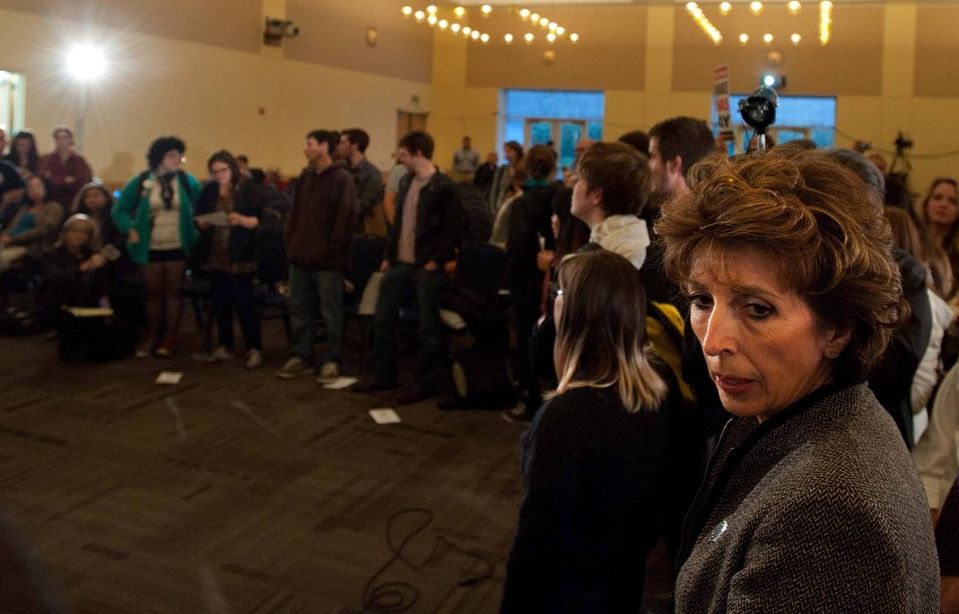
[http://www.sacbee.com/2011/11/29/4085704/protesters-disrupt-university.html]
Shouting protesters interrupted the University of California regents' meeting on Monday, but the mood was generally peaceful as students criticized officials' response to the use of police force and implored regents to back raising taxes on the wealthy to fund higher education.
Officials and members of the public were connected by teleconference from four UC campuses – in Davis, San Francisco, Merced and Los Angeles. After more than an hour and a half of public comment, regents began to move on with their agenda when they were interrupted by protesters in multiple locations.
Regents were discussing UC's 2012-13 budget request to the state when about a dozen protesters at UC Davis rose to their feet and, shouting in unison, declared the need for a "people's regents meeting." They moved from their chairs in the audience to the area in front of the dais, where they formed a circle and began their own discussion.
There was no response by campus police – who were stationed outside the meeting room in very small numbers – and Chancellor Linda Katehi briefly joined the group in the circle.
Around the same time, protesters in San Francisco and Los Angeles also disrupted the meeting with loud chants. Unable to hear, regents eventually disconnected from the teleconference and relocated to other rooms on the campuses. UC officials invited media to listen as regents reconvened the meeting by telephone.
Many participants decried the use of police force – pepper spraying in Davis and the use of batons in Berkeley – and criticized the investigation that UC is planning for not being independent.
Also on Monday:
• The union representing UC Berkeley police wrote a letter saying the video showing officers jabbing protesters with batons on Nov. 9 is misleading because it doesn't show officers being hit, pushed and threatened. The letter criticizes UC officials, saying they asked police to enforce their policies and then refused to stand by officers when they did so.
• Gov. Jerry Brown wrote a letter to the head of the state Commission on Peace Officer Standards and Training, asking that the agency review its crowd management and civil disobedience guidelines.
"I am seriously concerned that the rules governing the use of force, in particular the use of pepper spray, are not well understood in the context of civil disobedience and various forms of public protest," Brown wrote in the letter to Paul Cappitelli.
• UC President Mark Yudof announced he has appointed former California Supreme Court Justice Cruz Reynoso to chair the task force investigating the UC Davis police department's use of pepper spray. Reynoso is a professor emeritus at the UC Davis law school.
The big theme of the day was money – how UC could get more of it without asking students to pay higher tuition. The board approved an initial budget that asks the state for $2.78 billion in 2012-13, a 17 percent increase from the $2.37 billion it received this year.
Nathan Brostrom, UC's executive vice president, said regents would have to consider whether to raise tuition after seeing how much money is allotted to UC in Brown's January budget proposal.
Regents also approved several compensation items, including raises ranging from 6.4 percent to 21.9 percent for the head lawyers of six UC campuses. Steven Drown, chief counsel for UC Davis, received the largest raise, bringing his salary to $250,000.
Many students and union leaders who spoke pushed a five-point plan created by a union-backed group called Refund California. They asked regents to sign a pledge to support increasing income taxes on California's wealthiest, changing Proposition 13 to increase corporate property taxes, enacting a federal sales tax on large-scale financial transactions, reducing underwater mortgage debt, and reversing tuition increases, layoffs, and cuts to public education and other services.
"You said here today you're going to go and ask the state for more money, but you have no concrete proposal for where that money will come from or how it will get to UC," said Cheryl Deutsch, a UCLA grad student and leader of the United Auto Workers union that represents student employees. "The Refund California pledge offers concrete alternatives."
UC officials deflected the requests to sign onto the pledge but promised to work with students to petition the state for more money. Sherry Lansing, chair of the regents, asked students to organize a protest at the Capitol in January at which regents and students could march side by side.
Assembly Speaker John A. Pérez, a Democrat who sits on the board by virtue of his office, suggested that UC representatives target their message to Republican lawmakers, who oppose tax increases.
"It is not enough to come to Sacramento and talk to those of us who agree," Pérez said.
Outside on the UC Davis quad, about 80 tents were set up with Tibetan prayer flags strung between lampposts. Teach-ins were being held on the sidewalk and under a tarp-covered geodesic dome.
Students and other Occupy protesters marched to the student financial aid office in Dutton Hall. They filled the lobby and a second-story mezzanine chanting, "No cuts, no fees, education must be free."
"The way we guarantee victory is stay here and don't leave," said Monica Smith, a lawyer with a group called By Any Means Necessary, or BAMN. "If the police try to drag us out, we win because the whole world will be watching."
About 200 students sat or stood and listened to Nathan Brown, assistant professor of English, lecture on the socialist dialectic, quoting from Karl Marx's "The Communist Manifesto." University officials stood back and observed the proceedings, and a bicycle officer rode up and listened. Protesters said they planned to stay all night.
But most people at UC Davis appeared to have ignored the protesters' call for everyone on campus to strike Monday. Students biked to class, packed into Starbucks and hit the gym.
Melanie Lopez showed up at a small protest outside the regents meeting because her professor asked the class to meet there. But the 22-year-old senior from Fremont debated leaving to study elsewhere. She said she shares concerns about rising tuition but doesn't believe skipping class was the answer.
"We're paying money to go to class," she said. "And I don't want to waste that money."
BRYAN PATRICK / bpatrick@sacbee.com
UC Davis students occupying Dutton Hall listen as Nathan Brown, an assistant professor of English, lectures from the stairs Monday about socialism and Marxism. Protesters there and elsewhere also interrupted the UC regents’ long-distance meeting.
BRYAN PATRICK / bpatrick@sacbee.com
UC Davis Chancellor Linda Katehi listens as a dozen protesters declare a need for a “people’s regents meeting” at UC Davis. Protesters in San Francisco and Los Angeles also interrupted the regents, who then relocated to other rooms on the campuses.
2011-11-29 "Hungry much? California faces severe food aid gap in time of need" by Hugh Biggar
[http://www.sfbg.com/2011/11/29/hungry-much]
This story was funded by a grant from the Sierra Health Foundation to do independent reporting on the topic of food access in California.
---
Here's something to chew on with your bagel and coffee—assuming you can afford that in these trying times. Roughly, 2.3 million Californians are receiving official help getting enough to eat, but nearly 3 million others who qualify are not.
In fact, California's low enrollment in the federal food stamp program, known officially as the Supplemental Nutrition Assistance Program or in California, CalFresh, is costing the state both socially and economically.
"There's a deepening crisis," Matthew Sharp, a senior advocate with the nonprofit California Food Policy Advocates, said. "California's high housing costs and extreme unemployment are two forces that have put pressure on households."
Despite increasing need, however, less than half of those eligible for Cal Fresh assistance receive it, placing California next to last nationally. In other states, about 75 percent of those eligible for federal food stamp help take part, and some states are well above that threshold. Oregon, for instance, reaches about 90 percent of those who qualify.
In California, though, just about 43 percent of those eligible take part.
Socially, this means, of course, that millions of people are not getting enough to eat, leading to a range of other issues including health problems and hungry children underperforming at school. (In California, about 17 percent of children live in poverty, including roughly 3 million who qualify for free or reduced price meals.)
Economically, low participation in CalFresh also leaves money on the table at time when businesses and California's tax bureau are badly in need of funds. While the money per day may seem small, $4.50 for individual or about the cost of that bagel and coffee, it can still go a long way. Weekly CalFresh assistance equals $31 for an individual, or $325 monthly for a family of four.
"Food stamps stimulate the economy in a variety of ways," explained Chris Wimer, associate director of the Stanford Center for the Study of Poverty and Inequality.
For instance, the U.S. Department of Agriculture—the federal administrator of the food stamp program—has found that every $5 spent from food stamps generates about $9 in related economic activity.
Additionally, CFPA has found that boosting California's food stamp participation to the 75 percent level would generate about $131 million in sales tax revenue, including $27 million for non-general fund expenses.
But instead, low enrollment means California's loses out on about $5 billion annually or nearly $9 billion in related economic activity. On the county level, this includes losses as well. Los Angeles County is estimated to lose out on $1.3 billion in direct assistance and $2.4 billion in related activity; Alameda County, $106 million and $191 million; San Diego County, $354 million and $634 million.
At the same time, the level of need continues to increase due to a stalled economy and flat wages.
"Overall wages have dramatically declined, particularly in the services industries such as hotel workers," Sharp said from CFPA's Los Angeles office, noting that falling incomes have made Cal Fresh an increasingly common supplement to family's budgets.
In addition, the type of person in need of help has also shifted, and can include college students, those with jobs but not making enough to get by, and senior citizens.
"The variety of households taking part has increased astronomically," Sharp said. "This includes families that have never struggled with unemployment before and it has had a staggering effect on them."
Elizabeth Kneebone, a senior research associate at the Brookings Institution, also said the changing face of poverty now increasingly includes the suburbs as well as inner-city neighborhoods. In California, inland cities such as Riverside and Fresno have seen rapid spikes in suburban poverty, she said, sometimes double the levels in urban areas. (In a report published this month, Kneebone also determined that Fresno ranked fifth nationally for neighborhoods with extreme poverty.)
Despite this grim news, California is making some strides towards helping those in need.
In October, for example, Gov. Jerry Brown signed into law several bills that eliminated obstacles to CalFresh enrollment. Assembly Bill 6, for example, ended California's unusual requirement that mandated that everyone 18 and over in a household receiving CalFresh be finger printed. New laws have also ended a rule requiring CalFresh participants to file quarterly reports. Instead, California will switch to simplified semi-annual, or roughly twice a year reporting, beginning in 2013.
But there are still challenges and threats ahead.
"The recession has erased a lot of the social gains made during the 1990s, so it will take a number of years to make that up," said Caroline Danielson of the Public Policy Institute of California in Oakland. She also points to a need for smarter policies such as placing jobs closer to communities and public transit.
There is also concern that the current deficit reduction talks at the federal level could also add to the burden on households, increasing their need for supplemental help.
"The [deficit reduction talks] could reduce support for low-income families," Stanford's Wimer said. While the food stamp program may not be target, he added, related services such as a women and child component known as WIC could be on the chopping block.
"We'll have to see how it plays out," added CFPA's Sharp. "But right now there is extreme pressure on households and they are struggling to find adequate resources. It is certainly not unreasonable to try to close that 50 percent [CalFresh] gap."
[http://www.sfbg.com/2011/11/29/hungry-much]
This story was funded by a grant from the Sierra Health Foundation to do independent reporting on the topic of food access in California.
---
Here's something to chew on with your bagel and coffee—assuming you can afford that in these trying times. Roughly, 2.3 million Californians are receiving official help getting enough to eat, but nearly 3 million others who qualify are not.
In fact, California's low enrollment in the federal food stamp program, known officially as the Supplemental Nutrition Assistance Program or in California, CalFresh, is costing the state both socially and economically.
"There's a deepening crisis," Matthew Sharp, a senior advocate with the nonprofit California Food Policy Advocates, said. "California's high housing costs and extreme unemployment are two forces that have put pressure on households."
Despite increasing need, however, less than half of those eligible for Cal Fresh assistance receive it, placing California next to last nationally. In other states, about 75 percent of those eligible for federal food stamp help take part, and some states are well above that threshold. Oregon, for instance, reaches about 90 percent of those who qualify.
In California, though, just about 43 percent of those eligible take part.
Socially, this means, of course, that millions of people are not getting enough to eat, leading to a range of other issues including health problems and hungry children underperforming at school. (In California, about 17 percent of children live in poverty, including roughly 3 million who qualify for free or reduced price meals.)
Economically, low participation in CalFresh also leaves money on the table at time when businesses and California's tax bureau are badly in need of funds. While the money per day may seem small, $4.50 for individual or about the cost of that bagel and coffee, it can still go a long way. Weekly CalFresh assistance equals $31 for an individual, or $325 monthly for a family of four.
"Food stamps stimulate the economy in a variety of ways," explained Chris Wimer, associate director of the Stanford Center for the Study of Poverty and Inequality.
For instance, the U.S. Department of Agriculture—the federal administrator of the food stamp program—has found that every $5 spent from food stamps generates about $9 in related economic activity.
Additionally, CFPA has found that boosting California's food stamp participation to the 75 percent level would generate about $131 million in sales tax revenue, including $27 million for non-general fund expenses.
But instead, low enrollment means California's loses out on about $5 billion annually or nearly $9 billion in related economic activity. On the county level, this includes losses as well. Los Angeles County is estimated to lose out on $1.3 billion in direct assistance and $2.4 billion in related activity; Alameda County, $106 million and $191 million; San Diego County, $354 million and $634 million.
At the same time, the level of need continues to increase due to a stalled economy and flat wages.
"Overall wages have dramatically declined, particularly in the services industries such as hotel workers," Sharp said from CFPA's Los Angeles office, noting that falling incomes have made Cal Fresh an increasingly common supplement to family's budgets.
In addition, the type of person in need of help has also shifted, and can include college students, those with jobs but not making enough to get by, and senior citizens.
"The variety of households taking part has increased astronomically," Sharp said. "This includes families that have never struggled with unemployment before and it has had a staggering effect on them."
Elizabeth Kneebone, a senior research associate at the Brookings Institution, also said the changing face of poverty now increasingly includes the suburbs as well as inner-city neighborhoods. In California, inland cities such as Riverside and Fresno have seen rapid spikes in suburban poverty, she said, sometimes double the levels in urban areas. (In a report published this month, Kneebone also determined that Fresno ranked fifth nationally for neighborhoods with extreme poverty.)
Despite this grim news, California is making some strides towards helping those in need.
In October, for example, Gov. Jerry Brown signed into law several bills that eliminated obstacles to CalFresh enrollment. Assembly Bill 6, for example, ended California's unusual requirement that mandated that everyone 18 and over in a household receiving CalFresh be finger printed. New laws have also ended a rule requiring CalFresh participants to file quarterly reports. Instead, California will switch to simplified semi-annual, or roughly twice a year reporting, beginning in 2013.
But there are still challenges and threats ahead.
"The recession has erased a lot of the social gains made during the 1990s, so it will take a number of years to make that up," said Caroline Danielson of the Public Policy Institute of California in Oakland. She also points to a need for smarter policies such as placing jobs closer to communities and public transit.
There is also concern that the current deficit reduction talks at the federal level could also add to the burden on households, increasing their need for supplemental help.
"The [deficit reduction talks] could reduce support for low-income families," Stanford's Wimer said. While the food stamp program may not be target, he added, related services such as a women and child component known as WIC could be on the chopping block.
"We'll have to see how it plays out," added CFPA's Sharp. "But right now there is extreme pressure on households and they are struggling to find adequate resources. It is certainly not unreasonable to try to close that 50 percent [CalFresh] gap."
Monday, November 28, 2011
2011-11-28 "Protesters disrupt UC regents meeting in San Francisco" by Amy Crawford from "SF Examiner" newspaper
[http://www.sfexaminer.com/local/education/2011/11/protesters-disrupt-uc-regents-meeting-san-francisco#ixzz1f7naoUKH]
The revolution will be run according to parliamentary procedure.
Protesters who disrupted a meeting of the University of California regents at UC San Francisco’s Mission Bay campus Monday took over the boardroom and held their own meeting, voting on motions including a resolution demanding the resignation of top officials.
“We are inviting the regents to participate in a people’s regents meeting,” said UC Berkeley graduate student Erica Ward, who facilitated the assembly of a few dozen students, faculty, parents and staff.
The regents, scattered between four campuses and a Florida hotel, held their meeting by conference call. A gathering originally scheduled for two weeks ago was canceled amid fears of violence.
On Monday, regents allowed 90 minutes of comment, during which people at the four campuses criticized officials’ connections to moneyed interests and bemoaned tuition increases and budget cuts, as well as the violent response by university police to recent protests at UC Davis and UC Berkeley.
When public comment ended, Mission Bay protesters drowned out the voices of regents. Then, after rearranging their chairs into a circle, the protesters held a meeting governed by Robert’s Rules of Order, introducing a series of resolutions and voting with a show of hands.
“We demand that UC President Mark Yudof, the president of the university, and Chancellors [Robert] Birgeneau [of UC Berkeley] and [Linda] Katehi [of UC Davis] vacate those positions immediately,” proposed a UC Berkeley student who identified himself as Dan.
The resolution passed, 26 to 0.
Most of the regents present at Mission Bay retreated into another room, but Lt. Gov. Gavin Newsom joined the protesters. He expressed sympathy with their cause, but declined to sign when presented with a pledge to raise taxes on the rich.
“Every one of these things I am happy to orally commit to,” he said, while adding that he did not believe in signing pledges.
Meanwhile, the other regents continued their teleconference in another room, where they unanimously approved a 2012-13 budget including $6.5 billion in core operating expenditures, with $2.7 billion needed from the state. If Sacramento does not approve that request, tuition increases will be on the table.
[http://www.sfexaminer.com/local/education/2011/11/protesters-disrupt-uc-regents-meeting-san-francisco#ixzz1f7naoUKH]
The revolution will be run according to parliamentary procedure.
Protesters who disrupted a meeting of the University of California regents at UC San Francisco’s Mission Bay campus Monday took over the boardroom and held their own meeting, voting on motions including a resolution demanding the resignation of top officials.
“We are inviting the regents to participate in a people’s regents meeting,” said UC Berkeley graduate student Erica Ward, who facilitated the assembly of a few dozen students, faculty, parents and staff.
The regents, scattered between four campuses and a Florida hotel, held their meeting by conference call. A gathering originally scheduled for two weeks ago was canceled amid fears of violence.
On Monday, regents allowed 90 minutes of comment, during which people at the four campuses criticized officials’ connections to moneyed interests and bemoaned tuition increases and budget cuts, as well as the violent response by university police to recent protests at UC Davis and UC Berkeley.
When public comment ended, Mission Bay protesters drowned out the voices of regents. Then, after rearranging their chairs into a circle, the protesters held a meeting governed by Robert’s Rules of Order, introducing a series of resolutions and voting with a show of hands.
“We demand that UC President Mark Yudof, the president of the university, and Chancellors [Robert] Birgeneau [of UC Berkeley] and [Linda] Katehi [of UC Davis] vacate those positions immediately,” proposed a UC Berkeley student who identified himself as Dan.
The resolution passed, 26 to 0.
Most of the regents present at Mission Bay retreated into another room, but Lt. Gov. Gavin Newsom joined the protesters. He expressed sympathy with their cause, but declined to sign when presented with a pledge to raise taxes on the rich.
“Every one of these things I am happy to orally commit to,” he said, while adding that he did not believe in signing pledges.
Meanwhile, the other regents continued their teleconference in another room, where they unanimously approved a 2012-13 budget including $6.5 billion in core operating expenditures, with $2.7 billion needed from the state. If Sacramento does not approve that request, tuition increases will be on the table.
2011-11-28 "UC Davis Chancellor Katehi’s past: Police repression in Greece, FBI spying in the US"
by Jack Hood [http://www.wsws.org/en/articles/2011/11/kate-n28.html]:
The pepper spraying of peaceful student protesters at the University of California, Davis has become a focal point for national outrage over the police repression of demonstrations against social inequality.
The police action was ordered by UC Davis Chancellor Linda Katehi, who was acting on behalf of the UC Regents and the Democratic Party-controlled political establishment in California, which is determined to enforce a new round of drastic tuition increases on students. Katehi has spent the past week and a half defending herself against demands for her resignation, while making half-hearted attempts to distance herself from the police violence.
However, Katehi’s claims of innocence in the matter are belied by her past. She has played a major role in developing repressive measures against students protesting austerity measures and is a prime example of the growing nexus between corporate CEOs, academic administrators and the police-intelligence apparatus.
Katehi’s has been involved with police crackdowns in her home country of Greece, is one of 20 administrators involved in a national FBI network aimed at monitoring “anti-U.S.” activities on college campuses, and has overseen an administration-run campus infiltration program.
At a rally of students last Monday, Katehi made a backhanded reference to the suppression of Greek students during an uprising against the military junta in 1973. “There is a plaque out there that speaks about 17 of November in 1973, and I was there. And I don’t want to forget that, so I hope I will have a better opportunity to work with you, to meet you, to get to know you,” Katehi announced.
Aside from its hypocrisy, this reference contains an implicit threat. Katehi, as part of a team of bankers, speculators, and administrators, has worked to bring police back onto Greek university campuses after a nearly 30-year ban on such activity.
Campuses in Greece became an important focus of opposition to the Greek junta in 1973. Throughout the year, students gathered at Athens Polytechnic under the banner of “Bread, Education, Freedom” to protest the forced conscription of any students deemed to be “subversive.” In February of that year, students began a campus occupation. In November, they launched a general strike, which was met with military force on the 17th of the month.
The ultra right-wing dictatorship, with the help of fascist armed thugs, massacred 24 students as they successfully ended the occupation. Several of those killed were run over by tanks.
The brutality contributed to mass opposition that eventually led to the dictatorship’s downfall the following year. In 1982, the Greek parliament passed the Academic Asylum Law, which required police to request permission from a prosecutor before entering a campus.
Recently, however, Chancellor Katehi served on a team of representatives from the European Bank, European Commission, and International Monetary Fund, along with educators and administrators from across the world, to call for an end to these restrictions.
The team, called the “International Committee On Higher Education in Greece,” issued a report earlier this year, which Katehi co-signed, that called for an increase in police presence on campus under the guise of ensuring a “safe” environment.
“University campuses are unsafe,” the report claims. “While the [Greek] Constitution permits the university leadership to protect campuses from elements inciting political instability, Rectors have shown themselves unwilling to exercise these rights and fulfill their responsibilities, and to take the decisions needed in order to guarantee the safety of the faculty, staff, and students. As a result, the university administration and teaching staff have not proven themselves good stewards of the facilities with which society has entrusted them.
“The politicizing of universities – and in particular, of students – represents participation in the political process that exceeds the bounds of logic. This contributes to the rapid deterioration of tertiary education [emphasis added].”
According to the panel, then, peaceful student protesters like the ones who were pepper-sprayed at UC Davis “exceed the bounds of logic” and are helping to bring about the “rapid deterioration” of higher education.
The language used by the committee is strikingly similar to that used by the UC Davis administration to justify the deployment of police against students. On the morning of the police violence, the administration sent a letter to students warning that police action was necessary so that students “could learn and work in a safe, secure environment without disruption.”
In August, Greece’s PASOK government, headed by George Papandreou, approved the repeal of the Academic Asylum Law. Until his resignation on November 11, Papandreou oversaw the imposition of austerity measures dictated by the International Monetary Fund and the European banks, including further attacks on public education.
On November 17, 2011, the 38th anniversary of the massacre at Athens Polytechnic, the new Greek government authorized police entry at a university in Thessaloniki. This was the first time since 1982 that police have been allowed on a university campus.
FBI involvement
In the United States, Chancellor Katehi has participated in a national network of college presidents that works with the Federal Bureau of Investigation to “promote discussion and outreach between research universities and the FBI.”
The network is called the “National Security Higher Education Advisory Board,” and it is responsible for disseminating information regarding any activity by students and faculty that may be considered subversive.
The FBI has confirmed Katehi’s active involvement in the program. “Because of the nature of the material they discuss,” explains UC Davis administrator Andy Fell in a story from the campus faculty newspaper, Dateline, “board members must hold ‘secret’ security clearances.”
In light of this evidence of collusion with the FBI, the true meaning of Katehi’s claim that she wants to “get to know” students becomes clear.
Katehi herself boasted upon her appointment, telling the California Aggie, the UC Davis newspaper, in October 2010: “My participation allows me to visit with like-minded chancellors and presidents of major research institutions, to explore and share best practices that ensure our researchers and our research remain safe and unimpeded.”
That the real target of such activities is the politicization of students is made clear by Katehi’s involvement with the “Student Activism Response Team”—a group of 33 administrators from a variety of student service centers whose responsibility it is to infiltrate peaceful student demonstrations and disseminate information to the UC Davis Police Department. The team, active since at least 2009, is still in existence today.
The results of a Freedom of Information Act filing released last year documents the actions of the infiltration team. One email from an administrator released through the FOIA request, titled “Student Activism Response Protocol” and dated August 18, 2010, explains that administrators were given the responsibility to “receive information from all Student Affairs staff regarding any anticipated student actions, not just those of registered student organizations,” “inform police and request standby support if appropriate” and “notify and maintain communication with news service.”
Katehi’s sordid past and present actions exemplify a political establishment, comprised of both the Democrats and Republicans, that is thoroughly hostile to the interests of students, and ruthlessly determined to enforce the dictates of the corporate and financial elite in the face of growing mass opposition.
The pepper spraying of peaceful student protesters at the University of California, Davis has become a focal point for national outrage over the police repression of demonstrations against social inequality.
The police action was ordered by UC Davis Chancellor Linda Katehi, who was acting on behalf of the UC Regents and the Democratic Party-controlled political establishment in California, which is determined to enforce a new round of drastic tuition increases on students. Katehi has spent the past week and a half defending herself against demands for her resignation, while making half-hearted attempts to distance herself from the police violence.
However, Katehi’s claims of innocence in the matter are belied by her past. She has played a major role in developing repressive measures against students protesting austerity measures and is a prime example of the growing nexus between corporate CEOs, academic administrators and the police-intelligence apparatus.
Katehi’s has been involved with police crackdowns in her home country of Greece, is one of 20 administrators involved in a national FBI network aimed at monitoring “anti-U.S.” activities on college campuses, and has overseen an administration-run campus infiltration program.
At a rally of students last Monday, Katehi made a backhanded reference to the suppression of Greek students during an uprising against the military junta in 1973. “There is a plaque out there that speaks about 17 of November in 1973, and I was there. And I don’t want to forget that, so I hope I will have a better opportunity to work with you, to meet you, to get to know you,” Katehi announced.
Aside from its hypocrisy, this reference contains an implicit threat. Katehi, as part of a team of bankers, speculators, and administrators, has worked to bring police back onto Greek university campuses after a nearly 30-year ban on such activity.
Campuses in Greece became an important focus of opposition to the Greek junta in 1973. Throughout the year, students gathered at Athens Polytechnic under the banner of “Bread, Education, Freedom” to protest the forced conscription of any students deemed to be “subversive.” In February of that year, students began a campus occupation. In November, they launched a general strike, which was met with military force on the 17th of the month.
The ultra right-wing dictatorship, with the help of fascist armed thugs, massacred 24 students as they successfully ended the occupation. Several of those killed were run over by tanks.
The brutality contributed to mass opposition that eventually led to the dictatorship’s downfall the following year. In 1982, the Greek parliament passed the Academic Asylum Law, which required police to request permission from a prosecutor before entering a campus.
Recently, however, Chancellor Katehi served on a team of representatives from the European Bank, European Commission, and International Monetary Fund, along with educators and administrators from across the world, to call for an end to these restrictions.
The team, called the “International Committee On Higher Education in Greece,” issued a report earlier this year, which Katehi co-signed, that called for an increase in police presence on campus under the guise of ensuring a “safe” environment.
“University campuses are unsafe,” the report claims. “While the [Greek] Constitution permits the university leadership to protect campuses from elements inciting political instability, Rectors have shown themselves unwilling to exercise these rights and fulfill their responsibilities, and to take the decisions needed in order to guarantee the safety of the faculty, staff, and students. As a result, the university administration and teaching staff have not proven themselves good stewards of the facilities with which society has entrusted them.
“The politicizing of universities – and in particular, of students – represents participation in the political process that exceeds the bounds of logic. This contributes to the rapid deterioration of tertiary education [emphasis added].”
According to the panel, then, peaceful student protesters like the ones who were pepper-sprayed at UC Davis “exceed the bounds of logic” and are helping to bring about the “rapid deterioration” of higher education.
The language used by the committee is strikingly similar to that used by the UC Davis administration to justify the deployment of police against students. On the morning of the police violence, the administration sent a letter to students warning that police action was necessary so that students “could learn and work in a safe, secure environment without disruption.”
In August, Greece’s PASOK government, headed by George Papandreou, approved the repeal of the Academic Asylum Law. Until his resignation on November 11, Papandreou oversaw the imposition of austerity measures dictated by the International Monetary Fund and the European banks, including further attacks on public education.
On November 17, 2011, the 38th anniversary of the massacre at Athens Polytechnic, the new Greek government authorized police entry at a university in Thessaloniki. This was the first time since 1982 that police have been allowed on a university campus.
FBI involvement
In the United States, Chancellor Katehi has participated in a national network of college presidents that works with the Federal Bureau of Investigation to “promote discussion and outreach between research universities and the FBI.”
The network is called the “National Security Higher Education Advisory Board,” and it is responsible for disseminating information regarding any activity by students and faculty that may be considered subversive.
The FBI has confirmed Katehi’s active involvement in the program. “Because of the nature of the material they discuss,” explains UC Davis administrator Andy Fell in a story from the campus faculty newspaper, Dateline, “board members must hold ‘secret’ security clearances.”
In light of this evidence of collusion with the FBI, the true meaning of Katehi’s claim that she wants to “get to know” students becomes clear.
Katehi herself boasted upon her appointment, telling the California Aggie, the UC Davis newspaper, in October 2010: “My participation allows me to visit with like-minded chancellors and presidents of major research institutions, to explore and share best practices that ensure our researchers and our research remain safe and unimpeded.”
That the real target of such activities is the politicization of students is made clear by Katehi’s involvement with the “Student Activism Response Team”—a group of 33 administrators from a variety of student service centers whose responsibility it is to infiltrate peaceful student demonstrations and disseminate information to the UC Davis Police Department. The team, active since at least 2009, is still in existence today.
The results of a Freedom of Information Act filing released last year documents the actions of the infiltration team. One email from an administrator released through the FOIA request, titled “Student Activism Response Protocol” and dated August 18, 2010, explains that administrators were given the responsibility to “receive information from all Student Affairs staff regarding any anticipated student actions, not just those of registered student organizations,” “inform police and request standby support if appropriate” and “notify and maintain communication with news service.”
Katehi’s sordid past and present actions exemplify a political establishment, comprised of both the Democrats and Republicans, that is thoroughly hostile to the interests of students, and ruthlessly determined to enforce the dictates of the corporate and financial elite in the face of growing mass opposition.
Sunday, November 27, 2011
2011-11-22 "Calistoga police association head calls off boycott" by Sean Scully from "Calistoga Weekly" newspaper
[http://napavalleyregister.com/calistogan/news/local/calistoga-police-association-head-calls-off-boycott/article_2d88277e-154d-11e1-92a3-001cc4c002e0.html]
The head of the Calistoga Police Officers Association canceled the organization’s month-old boycott of city businesses late Monday and asked the community for forgiveness.
“It was my mistake to request California law enforcement and firefighter associations to no longer do business here,” President Mark Harden wrote in a letter to the editor [http://napavalleyregister.com/calistogan/news/opinion/police-officers-boycott-is-over/article_bd09df74-154c-11e1-bf2f-001cc4c002e0.html]. “I apologize to the business professionals and the residents of this fine community for this error, and will do all I can to spread the word that our association is rescinding that ill-timed request.”
Harden and the association declared the boycott in a letter to the editor published in The Weekly Calistogan on Oct. 27 [http://napavalleyregister.com/calistogan/news/opinion/editorial/city-council-left-officers-no-choice/article_f6214b12-001b-11e1-9d25-001cc4c03286.html]. It was intended to call attention to the officers’ unhappiness with the negotiations between the association and the city over a new labor contract. Those negotiations broke down in October, leading the City Council to impose a new contract forcing officers to pay more for pension and health insurance coverage.
Harden’s original letter outlined the officers’ complaints, including the amount the city spends on the community pool and a contract with the Chamber of Commerce to promote tourism.
The letter concluded, however, by saying that the association had contacted the mailing list of the 65,000-member Peace Officers Research Association of California urging all law enforcement officers to avoid spending money with Calistoga merchants. It also said that the association members would limit their spending in town and were actively seeking jobs elsewhere.
“I think if you go back to that last paragraph, it detracted from the point we were trying to make,” Harden said in a somewhat sheepish interview Monday, his first public comments since he announced the boycott.
The reaction to his original letter was furious, with city officials and both local newspapers flooded with angry letters from the business community and others. Some writers vented anger at Harden personally, others resurrected the idea of abolishing the police department and contracting with the county Sheriff’s Office for protection, an idea that has been considered and rejected by the City Council at least twice over the years.
Harden said the original letter was seen and approved by the 14 members of the association. His decision to rescind the boycott this week, however, is one he made alone for the good of the association, he said.
An early test of the level of damage the boycott has done will be the public response to the annual Christmas Food Basket program, in which the CPOA collects food and money to donate to needy families. That program kicked off Monday.
The Calistoga Chamber of Commerce reacted with wary surprise to Harden’s change of heart.
“We are certainly not going to forget this situation in the short term, but we look forward to the CPOA’s demonstration of their reconciliatory outreach through their future words and actions,” Executive Director Chris Canning said in a written statement [http://napavalleyregister.com/calistogan/news/opinion/chamber-hopes-to-move-forward/article_e8532e92-154c-11e1-86ab-001cc4c002e0.html].
City Manager Richard Spitler applauded the change.
“Obviously, the officers have to re-engage the community and the City Council members, and I think we as a city … have to allow for that to happen,” he said. “We have to leave the lines of communication open.”
He said rescinding the boycott now will allow time for emotions to settle before the association and the city have to go back to the bargaining table to hammer out a new contract. The old contract, imposed by the City Council, expires June 30 and a new round of negotiations will start in the spring.
[http://napavalleyregister.com/calistogan/news/local/calistoga-police-association-head-calls-off-boycott/article_2d88277e-154d-11e1-92a3-001cc4c002e0.html]
The head of the Calistoga Police Officers Association canceled the organization’s month-old boycott of city businesses late Monday and asked the community for forgiveness.
“It was my mistake to request California law enforcement and firefighter associations to no longer do business here,” President Mark Harden wrote in a letter to the editor [http://napavalleyregister.com/calistogan/news/opinion/police-officers-boycott-is-over/article_bd09df74-154c-11e1-bf2f-001cc4c002e0.html]. “I apologize to the business professionals and the residents of this fine community for this error, and will do all I can to spread the word that our association is rescinding that ill-timed request.”
Harden and the association declared the boycott in a letter to the editor published in The Weekly Calistogan on Oct. 27 [http://napavalleyregister.com/calistogan/news/opinion/editorial/city-council-left-officers-no-choice/article_f6214b12-001b-11e1-9d25-001cc4c03286.html]. It was intended to call attention to the officers’ unhappiness with the negotiations between the association and the city over a new labor contract. Those negotiations broke down in October, leading the City Council to impose a new contract forcing officers to pay more for pension and health insurance coverage.
Harden’s original letter outlined the officers’ complaints, including the amount the city spends on the community pool and a contract with the Chamber of Commerce to promote tourism.
The letter concluded, however, by saying that the association had contacted the mailing list of the 65,000-member Peace Officers Research Association of California urging all law enforcement officers to avoid spending money with Calistoga merchants. It also said that the association members would limit their spending in town and were actively seeking jobs elsewhere.
“I think if you go back to that last paragraph, it detracted from the point we were trying to make,” Harden said in a somewhat sheepish interview Monday, his first public comments since he announced the boycott.
The reaction to his original letter was furious, with city officials and both local newspapers flooded with angry letters from the business community and others. Some writers vented anger at Harden personally, others resurrected the idea of abolishing the police department and contracting with the county Sheriff’s Office for protection, an idea that has been considered and rejected by the City Council at least twice over the years.
Harden said the original letter was seen and approved by the 14 members of the association. His decision to rescind the boycott this week, however, is one he made alone for the good of the association, he said.
An early test of the level of damage the boycott has done will be the public response to the annual Christmas Food Basket program, in which the CPOA collects food and money to donate to needy families. That program kicked off Monday.
The Calistoga Chamber of Commerce reacted with wary surprise to Harden’s change of heart.
“We are certainly not going to forget this situation in the short term, but we look forward to the CPOA’s demonstration of their reconciliatory outreach through their future words and actions,” Executive Director Chris Canning said in a written statement [http://napavalleyregister.com/calistogan/news/opinion/chamber-hopes-to-move-forward/article_e8532e92-154c-11e1-86ab-001cc4c002e0.html].
City Manager Richard Spitler applauded the change.
“Obviously, the officers have to re-engage the community and the City Council members, and I think we as a city … have to allow for that to happen,” he said. “We have to leave the lines of communication open.”
He said rescinding the boycott now will allow time for emotions to settle before the association and the city have to go back to the bargaining table to hammer out a new contract. The old contract, imposed by the City Council, expires June 30 and a new round of negotiations will start in the spring.
2011-11-27 "10th Annual Black Friday Demonstration to Protest Desecration of Sacred Ohlone Shellmounds"
by Alex Darocy (alex (@ alexdarocy.com) [http://www.indybay.org/newsitems/2011/11/27/18701083.php]:
For the 10th straight year, community members gathered on Black Friday to protest the desecration of the sacred Ohlone shellmounds in Emeryville that were disturbed when the Bay Street Mall was constructed on top of them. The demonstration was on November 25 this year, and organizers of the event hoped to educate shoppers about the Ohlone burial sites, and that there were other shopping alternatives located nearby.
In 2000 the Bay Street Mall was built atop the largest and oldest Ohlone burial site in the Bay Area, amid protests. Before the desecration, the shellmounds at the location stood nearly as tall as the current structures. During construction, thousands of Ohlone ancestors were removed from the site, and hundreds were left in the ground and were eventually built on top of. The Victoria's Secret store on Bay Street sits atop burials that were not removed. Since the desecration, demonstrations at the site have been held every year on Black Friday.
A short rally during this year's demonstration featured speeches by Ohlone and Native American activists as well as a representative of Occupy/Decolonize Oakland. Native American community members also sang songs, drummed, and played clap sticks. A list containing the names of alternative chain store locations was handed out to shoppers in addition to other printed materials.
For information about shellmounds in the Bay Area, see:
http://ipocshellmoundwalk.intuitwebsites.com/shellmound.html


All photos by Alex Darocy

Prayer Circle, Shellmound Street

The Dead Mall

Warning: Bad Karma

You Support Genocide (w. Tim Killings of Laney College BSU, and BRLP showing solidarity)

Don't Buy These (protest for "Buy Nothing Day")

Solidarity from Occupy Oakland

For the 10th straight year, community members gathered on Black Friday to protest the desecration of the sacred Ohlone shellmounds in Emeryville that were disturbed when the Bay Street Mall was constructed on top of them. The demonstration was on November 25 this year, and organizers of the event hoped to educate shoppers about the Ohlone burial sites, and that there were other shopping alternatives located nearby.
In 2000 the Bay Street Mall was built atop the largest and oldest Ohlone burial site in the Bay Area, amid protests. Before the desecration, the shellmounds at the location stood nearly as tall as the current structures. During construction, thousands of Ohlone ancestors were removed from the site, and hundreds were left in the ground and were eventually built on top of. The Victoria's Secret store on Bay Street sits atop burials that were not removed. Since the desecration, demonstrations at the site have been held every year on Black Friday.
A short rally during this year's demonstration featured speeches by Ohlone and Native American activists as well as a representative of Occupy/Decolonize Oakland. Native American community members also sang songs, drummed, and played clap sticks. A list containing the names of alternative chain store locations was handed out to shoppers in addition to other printed materials.
For information about shellmounds in the Bay Area, see:
http://ipocshellmoundwalk.intuitwebsites.com/shellmound.html
All photos by Alex Darocy
Prayer Circle, Shellmound Street
The Dead Mall
Warning: Bad Karma
You Support Genocide (w. Tim Killings of Laney College BSU, and BRLP showing solidarity)
Don't Buy These (protest for "Buy Nothing Day")
Solidarity from Occupy Oakland
2011-11-27 "Vallejo foreclosures spur surge in squatters" by Irma Widjojo from "Vallejo Times-Herald"
[http://www.timesheraldonline.com/ci_19420543]
Real estate agent Greg Roherer talks about a large picture window in a home that he is renovating which has been broken several times. Roherer's property is next door to home suspected of housing squatters. Apart from broken windows Roherer has found garbage dumped over his fence and electrical cords running into his home to steal electricity. (Chris Riley/Times-Herald)
As a real estate agent, Greg Rohrer bought the foreclosed house in the 300 block of Central Avenue in December to turn it into a rental property. Little did he know, the process was going to be more costly than he ever imagined.
Rohrer's property is next to a vacant home that has now been occupied by squatters.
He said he had found the people stealing electricity and power by running a hose and a cable onto his property. Rohrer also found garbage being dumped in his driveway and yard.
In all, it cost him thousands of dollars more than he expected. It cost him a little less than $2,000 alone to replace numerous broken windows. That doesn't include costs for cleaning up the garbage spewed around the property.
"I can't really say I know who did it," he said. "But this home is a nuisance."
Many neighborhood residents agree with Rohrer.
A mother of a 2-year-old boy said she has heard and seen many loud arguments in front of the vacant property.
"My son has started picking up bad words from them," she said.
The woman requested anonymity for fear of retribution.
The Central Avenue home is only one of 1,325 properties in Vallejo that were in some form of foreclosure as of last week, according to city of Vallejo Code Enforcement division numbers.
"It is a significant problem," Code Enforcement Manager Nimat Shakoor-Grantham said.
The division is responsible for ensuring that the exteriors of these vacant properties meet city code requirements, including being free of junk and overgrown weeds. The city cites owners of properties that fail to do so.
Shakoor-Grantham said she has noticed an increase in complaints about squatters since 2007 and 2008, the beginning of the real estate bust in Vallejo.
Shakoor-Grantham said, "99.9 percent of the time, if the property has been foreclosed, people abandon them."
However, Code Enforcement lacks the power to evict those who move in on abandoned property.
"Only the owners can evict the squatters," she added.
This has been proven difficult, especially if properties are owned by banks, as most are, Shakoor-Grantham said.
"Only once or twice since 2008 has a bank replied to us," Shakoor-Grantham said.
The Central Avenue home was foreclosed on in 2010, and is listed with the city of Vallejo to be owned by Fannie Mae. However, when contacted by the Times-Herald, a Fannie Mae representative said the home had been sold to a "servicer." No further explanation was given after further inquiries.
Code Enforcement has sent Fannie Mae a citation for more than $2,300 in penalties regarding the Central Avenue property, Shakoor-Grantham said. She said she has yet to receive any response from Fannie Mae.
The Vallejo Police Department has also received reports about squatters since the number of foreclosures increased.
"It was something that almost never occurred before, but because we have more vacant properties, it does occur occasionally now," Vallejo police spokesman Sgt. Jeff Bassett said.
However, the police are limited in what they can do when unable to interact with a property's owner.
"We have to determine who the owner is and they need to tell us that the people don't belong there," Bassett said. "It's extremely hard to reach the banks or owner."
With such difficulties in abating the squatting issue, many neighborhoods have taken a proactive stance by forming neighborhood watch groups.
Vallejo has 350 neighborhood watch groups, according to Fighting Back Partnership, which helps form them. Thatis significantly higher than just 10 groups in 2009.
These groups can sue property owners for quality-of-life issues and take them to small claims court, said Bob Sampayan of Fighting Back Partnership. Sampayan, recently elected to the Vallejo City Council, said he has helped neighborhood groups in six cases, five of which were successful.
The civil nuisance abatement process requires the residents of a neighborhood to record all issues caused by squatters, including psychological impacts. Each resident must pay $75 per person to file the paperwork. It takes as long as 30 days to get a court date after the filing date, and the judge has up to 90 days to respond after the hearing, Sampayan said.
"The process does work," he said. "Sadly, we don't have enough city employees to handle problems such as this. Hopefully in the future, we will. Until then, neighbors have to help neighbors."
Sampayan added that he understands the plight homeless people face, especially during winter.
"It's sad because there's a lot of homeless folk out there, and I understand why they (squat) especially in cold and rainy weather like this," he said. "But they are doing a long-term harm to the neighborhood."
Sampayan suggested residents go to a local branch of the bank, provided the owner of the property is a bank, and demand to be connected to the bank's asset protection department to discuss the property.
"Neighbors need to be more proactive," he said.
A resident in the area of the Central Avenue property is doing just that. She and a few other neighbors are forming a neighborhood watch group.
"I feel like the neighborhood watch program has done so much good for this community," the resident said. "We want to clean Vallejo up. It has so much potential, it just needs some love."
For more information about forming a neighborhood watch group, call Sampayan at (707)648-5230 during normal business hours on Tuesdays, Wednesdays and Thursdays.
[http://www.timesheraldonline.com/ci_19420543]
Real estate agent Greg Roherer talks about a large picture window in a home that he is renovating which has been broken several times. Roherer's property is next door to home suspected of housing squatters. Apart from broken windows Roherer has found garbage dumped over his fence and electrical cords running into his home to steal electricity. (Chris Riley/Times-Herald)
As a real estate agent, Greg Rohrer bought the foreclosed house in the 300 block of Central Avenue in December to turn it into a rental property. Little did he know, the process was going to be more costly than he ever imagined.
Rohrer's property is next to a vacant home that has now been occupied by squatters.
He said he had found the people stealing electricity and power by running a hose and a cable onto his property. Rohrer also found garbage being dumped in his driveway and yard.
In all, it cost him thousands of dollars more than he expected. It cost him a little less than $2,000 alone to replace numerous broken windows. That doesn't include costs for cleaning up the garbage spewed around the property.
"I can't really say I know who did it," he said. "But this home is a nuisance."
Many neighborhood residents agree with Rohrer.
A mother of a 2-year-old boy said she has heard and seen many loud arguments in front of the vacant property.
"My son has started picking up bad words from them," she said.
The woman requested anonymity for fear of retribution.
The Central Avenue home is only one of 1,325 properties in Vallejo that were in some form of foreclosure as of last week, according to city of Vallejo Code Enforcement division numbers.
"It is a significant problem," Code Enforcement Manager Nimat Shakoor-Grantham said.
The division is responsible for ensuring that the exteriors of these vacant properties meet city code requirements, including being free of junk and overgrown weeds. The city cites owners of properties that fail to do so.
Shakoor-Grantham said she has noticed an increase in complaints about squatters since 2007 and 2008, the beginning of the real estate bust in Vallejo.
Shakoor-Grantham said, "99.9 percent of the time, if the property has been foreclosed, people abandon them."
However, Code Enforcement lacks the power to evict those who move in on abandoned property.
"Only the owners can evict the squatters," she added.
This has been proven difficult, especially if properties are owned by banks, as most are, Shakoor-Grantham said.
"Only once or twice since 2008 has a bank replied to us," Shakoor-Grantham said.
The Central Avenue home was foreclosed on in 2010, and is listed with the city of Vallejo to be owned by Fannie Mae. However, when contacted by the Times-Herald, a Fannie Mae representative said the home had been sold to a "servicer." No further explanation was given after further inquiries.
Code Enforcement has sent Fannie Mae a citation for more than $2,300 in penalties regarding the Central Avenue property, Shakoor-Grantham said. She said she has yet to receive any response from Fannie Mae.
The Vallejo Police Department has also received reports about squatters since the number of foreclosures increased.
"It was something that almost never occurred before, but because we have more vacant properties, it does occur occasionally now," Vallejo police spokesman Sgt. Jeff Bassett said.
However, the police are limited in what they can do when unable to interact with a property's owner.
"We have to determine who the owner is and they need to tell us that the people don't belong there," Bassett said. "It's extremely hard to reach the banks or owner."
With such difficulties in abating the squatting issue, many neighborhoods have taken a proactive stance by forming neighborhood watch groups.
Vallejo has 350 neighborhood watch groups, according to Fighting Back Partnership, which helps form them. Thatis significantly higher than just 10 groups in 2009.
These groups can sue property owners for quality-of-life issues and take them to small claims court, said Bob Sampayan of Fighting Back Partnership. Sampayan, recently elected to the Vallejo City Council, said he has helped neighborhood groups in six cases, five of which were successful.
The civil nuisance abatement process requires the residents of a neighborhood to record all issues caused by squatters, including psychological impacts. Each resident must pay $75 per person to file the paperwork. It takes as long as 30 days to get a court date after the filing date, and the judge has up to 90 days to respond after the hearing, Sampayan said.
"The process does work," he said. "Sadly, we don't have enough city employees to handle problems such as this. Hopefully in the future, we will. Until then, neighbors have to help neighbors."
Sampayan added that he understands the plight homeless people face, especially during winter.
"It's sad because there's a lot of homeless folk out there, and I understand why they (squat) especially in cold and rainy weather like this," he said. "But they are doing a long-term harm to the neighborhood."
Sampayan suggested residents go to a local branch of the bank, provided the owner of the property is a bank, and demand to be connected to the bank's asset protection department to discuss the property.
"Neighbors need to be more proactive," he said.
A resident in the area of the Central Avenue property is doing just that. She and a few other neighbors are forming a neighborhood watch group.
"I feel like the neighborhood watch program has done so much good for this community," the resident said. "We want to clean Vallejo up. It has so much potential, it just needs some love."
For more information about forming a neighborhood watch group, call Sampayan at (707)648-5230 during normal business hours on Tuesdays, Wednesdays and Thursdays.
Subscribe to:
Posts (Atom)