2011-04-05 "Richmond cops accused of hiring, arming Explorers" by Demian Bulwa,Justin Berton from "San Francisco Chronicle" newspaper
[http://www.sfgate.com/cgi-bin/article.cgi?f=/c/a/2011/04/05/MNNA1IO6BD.DTL&type=printable]
The FBI and the Richmond Police Department are investigating allegations that two officers recruited teens from the department's Explorer program into their private security firm, illegally armed them with guns and sent them to patrol the city's most dangerous housing complexes, The Chronicle has learned.
After two of the Explorers complained about their jobs, they had a falling-out with their mentors. The officers then hired a private investigator who used attractive decoys to try to coax one of the young men into a drunken-driving arrest, according to the women who took part in the setup.
The young man, Sergio Rios, now 21, and his best friend, 22-year-old Orlando Torres, are at the center of the investigation. The officers, Danny Harris and Ray Thomas, are on paid leave and have accused their department of targeting them because they are African American.
For years, the officers headed a program created to give aspiring cops a first look at the job. But Rios and Torres told The Chronicle that Harris illegally bought them pistols for guard duty when they were 19 and 20 years old, respectively.
The young men said they gave Harris $500 apiece to buy the guns, which came with high-capacity magazines that civilians cannot legally carry in California.
Under federal law, people under 21 cannot buy handguns, and buying a gun for another person - regardless of age - is considered an illegal "straw purchase." Rios said he was 19 at the time Harris bought his gun, and Torres said he was 20.
"Usually you look at cops as role models, not people who want to destroy you," said Torres, who now works in loss prevention for a major retailer and still wants to become a police officer.
Several sources said the FBI is investigating the officers, which Rios and Torres confirmed. An agency spokesman declined to comment.
Thomas said in an interview with The Chronicle that he had done nothing wrong, and an attorney for Harris declined to comment.
Side business -
The ongoing investigation into these allegations is the latest to involve Christopher Butler, a private investigator and former Antioch police officer who has been accused of working with other law enforcement contacts to set up people for arrest - much in the same way that Rios believes Butler targeted him using the decoys.
Butler, 49, was arrested Feb. 16 along with a state narcotics officer and has pleaded not guilty to charges of selling drugs stolen from evidence lockers.
Richmond Police Chief Chris Magnus said he could not speak in detail about Harris and Thomas because they are part of an ongoing investigation by the Police Department and because they have confidentiality rights.
Magnus did say his department bars officers from moonlighting in private security. Records show that the department ordered Harris and Thomas to stop, but that they did not.
"If you have a police officer operating a security company, that has the potential to give them an unfair competitive advantage," Magnus said. "It suggests they're bringing to bear the resources of the police agency they are working for."
In an interview, Thomas confirmed that he and Harris started a security business and that Magnus disapproved of it. But he said the department's policy was unfair, and that he had launched the business after getting permission in 2005 from then-Police Chief Terry Hudson. Hudson could not be reached for comment.
Racism charge -
Magnus, Thomas said, is targeting him and Harris because they accused the chief of discrimination in an ongoing lawsuit filed in June 2010, after the department began its investigation. Both officers are African American.
Magnus said the charge is "without merit."
Thomas said he did not hire Butler. He called former Explorers Rios and Torres "compulsive liars."
"We have done nothing wrong," Thomas said. "These guys have done everything they can to sabotage us."
Thomas said neither Rios nor Torres was provided a gun to carry while doing security work. And he said many former Explorers ended up as security guards at his firm because Rios and Torres recruited them and had the authority to hire them.
Rios responded, "Anyone that was hired had to be approved by Danny." He said about 18 former Explorers had worked for the security firm.
Richmond's Explorer program is an affiliate of the Boy Scouts of America. The young men and women, who are ages 14 to 20, are trained on police procedure, provide security at some city events and perform clerical duties. The program is registered as a nonprofit with the IRS.
Magnus said that other officers now run it and that layers of oversight have been added.
Aspiring cops -
Torres and Rios, who are neighbors and best friends, said they joined as a first step toward potential law enforcement careers. Harris, a former Explorer, ran it with help from Thomas.
As time went on, the young men said, Harris began to shift his focus. At an Explorer meeting about two years ago, Rios said, Harris asked him and Torres to work for his security firm, which was in the process of securing a contract with the owner of the violence-plagued Crescent Park housing complex in Richmond.
"I thought it would be a great opportunity," said Rios. "I was young and wanted to try something kind of new that was similar" to police work.
Rios and Torres said Harris subsequently took them to LC Action Police Supply in San Jose. They said they each gave $500 in cash to Harris, who bought them Glock pistols to carry on the job.
Rios said Harris transferred his gun into Rios' father's name in February 2010.
Rios' father, who is also named Sergio Rios, said he had trusted Harris and had been glad to see his son find a job in a tough market.
Ordered to stop -
As the officers built their side business in 2009 and 2010, they faced resistance at the police station, records show.
According to documents filed in the discrimination lawsuit, the department ordered Harris and Thomas in January 2010 to cease their involvement in the security business, which was then called Strategic Alliance Protective Services, and said they had used their status as officers to secure contracts - an allegation that Thomas denies.
Four months later, the department disciplined the officers. Court records do not detail the type of punishment.
By last summer, the officers' security business had more mundane problems. Rios and Torres said they and more than a dozen other employees - upset at what they viewed as unfair wages and work conditions - traveled together to the Oakland Labor Board to inquire about filing a complaint.
The young men said Harris found out about the trip and had a senior manager place them "on call," giving them no further shifts.
Torres said that in the ensuing weeks, Thomas repeatedly called him and sent him messages on Facebook trying to get Harris' pistol back. Torres said he initially refused because he had paid for it, despite Harris being the registered owner.
The Police Department took custody of both guns, though, after Rios took the young men's complaints to internal affairs in early September.
Gun suit -
Later that month, court records show, Officer Thomas tried to retrieve Torres' gun by suing him in small claims court.
"I purchased a handgun from the original owner," Thomas wrote to the court, referring to Harris. "The defendant is aware of this and refuses to provide me my handgun."
The lawsuit was so unusual that Torres said he got a call from a producer for a television courtroom show, asking if he and Thomas would sort out their differences on air.
But internal affairs investigators stepped in, records show, telling the court that the gun was in police custody and that they would handle the matter from there.
Thomas told The Chronicle there was an innocent explanation for the small claims suit, which would come out in court.
"I've got documentation from (Torres) that will blow that claim out of the water," he said, declining to elaborate.
The sting -
On Nov. 7, Rios said, two women aggressively came on to him during his shift as a newly hired security guard at an Emeryville movie theater.
In the following weeks, the women texted Rios sexually suggestive remarks - which he showed The Chronicle - and sent him a picture of them posing in lingerie.
In interviews with The Chronicle, the women in the sting said they had worked for private investigator Butler, who according to Contra Costa County prosecutors had a pattern of setting up men.
A county prosecutor said Butler orchestrated DUI arrests - hiring women to get male targets drunk at bars, arranging with police friends to have them arrested for drunken driving, then using the arrest as leverage in child custody cases.
In the Rios sting, the women who worked as decoys said Butler gave explicit instructions to get the young man drunk and lead him in his car north through neighboring Danville, where a police officer would make a prearranged traffic stop.
The women, who spoke on condition of anonymity, said they were encouraged to get Rios to bring a gun, because if he were stopped with the firearm while driving drunk, he could face prison time.
Though Thomas denies hiring Butler, one of the decoys told The Chronicle she met with Thomas and Harris outside Butler's office on his behalf to debrief them on the ongoing Rios sting.
The tipster -
On Dec. 5, the day the women were going to meet Rios at a San Ramon Chevy's restaurant, one texted, "Will u bring ur gun so we can take a picture with it?"
What they didn't know was that a day earlier, an anonymous tipster contacted Rios through a Facebook account - under the fake name "Suzy Smith" - and warned him not to go.
"You don't deserve what is about to happen," said the message, which Rios showed The Chronicle. "It is former employers of yours that are setting you up."
The tipster knew every detail about the women and the date. Rios said he immediately sent back his phone number, and that the two spoke. The tipster, Rios said, revealed that Harris and Thomas had hired Butler.
The women confirmed to The Chronicle that they waited at the bar for Rios to show up - until it closed.
"I didn't expect that from them," Rios said of his onetime mentors. "For them to go from being so positive to being so negative, it brings me down as far as how I look at other police officers. I hope other officers aren't the same."
Tuesday, April 5, 2011

Monday, April 4, 2011
2011-04-04 "Unions Rally to Support Each Other: On the anniversary of Martin Luther King, Jr's death, unions took to the streets, including in Martinez, to show solidarity for labor and workers" by Jim Caroompas from "Martinez Patch"
[http://martinez.patch.com/articles/unions-rally-to-support-each-other#c]
On Monday afternoon, April 4, a noisy, enthusiastic group of men and women gathered on the sidewalk in front of the United Federation of Communication Workers Local 5 on Alhambra Avenue and held signs, made noise, and showed solidarity to each other and the passing traffic. The message was clear - unions are good, and public employees are not the enemy.
It's not a message everyone agrees with these days, particularly in the halls of power. Recent events in Wisconsin and Ohio - where the right to collective bargaining has been severely reduced - have union employees, and public employees in particular, concerned that soaring budget deficits are being blamed on their benefits and pensions.
So unions around California, and in Martinez, decided to take a public stand on the anniversary of the assassination of Martin Luther King, Jr., whose final act was to stand with sanitation workers striking for collective bargaining rights. Martinez Patch was there to capture some of the action.


[http://martinez.patch.com/articles/unions-rally-to-support-each-other#c]
On Monday afternoon, April 4, a noisy, enthusiastic group of men and women gathered on the sidewalk in front of the United Federation of Communication Workers Local 5 on Alhambra Avenue and held signs, made noise, and showed solidarity to each other and the passing traffic. The message was clear - unions are good, and public employees are not the enemy.
It's not a message everyone agrees with these days, particularly in the halls of power. Recent events in Wisconsin and Ohio - where the right to collective bargaining has been severely reduced - have union employees, and public employees in particular, concerned that soaring budget deficits are being blamed on their benefits and pensions.
So unions around California, and in Martinez, decided to take a public stand on the anniversary of the assassination of Martin Luther King, Jr., whose final act was to stand with sanitation workers striking for collective bargaining rights. Martinez Patch was there to capture some of the action.


"Oakland OEA Teachers Speakout On 4/4/11 at Well Fargo Bank - Make The Banks Pay!!"
[http://www.youtube.com/watch?v=TbYWpeIiTZM]
On April 4, 2011 at the Wells Fargo Bank in Oakland, California, the Oakland Education Association with the support of other unions and workers demanded that the bank pay for the massive budget deficit in the Oakland schools.
Oakland Education Association OEA leaders spoke out about what education is facing and how to solve the crisis.
Production of Labor Video Project
[laborvideo.blip.tv]
[www.laborvideo.org]
[http://www.youtube.com/watch?v=TbYWpeIiTZM]
On April 4, 2011 at the Wells Fargo Bank in Oakland, California, the Oakland Education Association with the support of other unions and workers demanded that the bank pay for the massive budget deficit in the Oakland schools.
Oakland Education Association OEA leaders spoke out about what education is facing and how to solve the crisis.
Production of Labor Video Project
[laborvideo.blip.tv]
[www.laborvideo.org]
2011-04-08 "Crockett Labor Demonstration 4/4/11" by Ed Rippy [member of UFCW Local 5]
[http://www.indybay.org/newsitems/2011/04/08/18676704.php]
CROCKETT--On April 4th several hundred people rallied in solidarity with workers in Wisconsin who are facing attacks on their right to organize. Members from many unions showed up, along with the Mt. Diablo Peace and Justice Center, MoveOn.org, and other groups. State Assemblywoman Nancy Skinner, State Senator Mark DeSaulnier, and US Congressman George Miller sent staff members; Congressman Miller sent a message of support, and Senator DeSaulnier called from Sacramento to speak to the crowd. After a short rally, activists marched onto the Alfred Zampa bridge and met a similar group from Napa/Solano that had rallied at the other end of the bridge.
Speakers included Pam Aguilar, Executive Director of the Contra Costa Central Labor Council and Carole Travis, Chair of the Board of the Mt. Diablo Peace and Justice Center.
Speeches:
* Carole Travis (4:26) [http://www.indybay.org/uploads/2011/04/08/carole_travis_spch.mp3]
* Pam Aguilar (1:55) [http://www.indybay.org/uploads/2011/04/08/pam_aguilar_spch.mp3]
interviews:
* Oscar Orozco (UFCW Local 5) (:43) [http://www.indybay.org/uploads/2011/04/08/oscar_orozco_intv.mp3]
* Pam Aguilar (1:07) [http://www.indybay.org/uploads/2011/04/08/pam_aguilar_intv.mp3]
---
Workers and peace activists from Contra Costa and Napa/Solano rallied at Alfred Zampa bridge.
Photos by Jack Landes (UFCW Local 5).


[http://www.indybay.org/newsitems/2011/04/08/18676704.php]
CROCKETT--On April 4th several hundred people rallied in solidarity with workers in Wisconsin who are facing attacks on their right to organize. Members from many unions showed up, along with the Mt. Diablo Peace and Justice Center, MoveOn.org, and other groups. State Assemblywoman Nancy Skinner, State Senator Mark DeSaulnier, and US Congressman George Miller sent staff members; Congressman Miller sent a message of support, and Senator DeSaulnier called from Sacramento to speak to the crowd. After a short rally, activists marched onto the Alfred Zampa bridge and met a similar group from Napa/Solano that had rallied at the other end of the bridge.
Speakers included Pam Aguilar, Executive Director of the Contra Costa Central Labor Council and Carole Travis, Chair of the Board of the Mt. Diablo Peace and Justice Center.
Speeches:
* Carole Travis (4:26) [http://www.indybay.org/uploads/2011/04/08/carole_travis_spch.mp3]
* Pam Aguilar (1:55) [http://www.indybay.org/uploads/2011/04/08/pam_aguilar_spch.mp3]
interviews:
* Oscar Orozco (UFCW Local 5) (:43) [http://www.indybay.org/uploads/2011/04/08/oscar_orozco_intv.mp3]
* Pam Aguilar (1:07) [http://www.indybay.org/uploads/2011/04/08/pam_aguilar_intv.mp3]
---
Workers and peace activists from Contra Costa and Napa/Solano rallied at Alfred Zampa bridge.
Photos by Jack Landes (UFCW Local 5).


2011-04-04 "No Injunction Needed in West Sacramento" by David Greenwald
[http://davisvanguard.org/index.php?option=com_content&view=article&id=4233:vanguard-commentary-no-injunction-needed-in-west-sacramento&catid=74:judicial-watch&Itemid=100]
Evidence At Trial Shows Neither a Clear Criminal Street Gang nor a Nuisance in West Sacramento -
At the core of the Yolo County judicial problem is the gang case. Time after time, I see these young, relatively innocent, sometimes even harmless looking kids being accused of being gang members and committing some other crime.
As I sit there in the courtroom I cannot help but believe that we as a society have failed these kids, allowing them to get this to point. The term gang and gang member inspires fear more than compassion. It conjures visions of hardened criminal street gang members brazenly shooting and killing helpless and innocent victims.
But you can count on your hands the number of murders in Yolo County each year and you can count on one hand the number of gang murders in Yolo County over even the last decade.
The reality is that the image of gang member is not what you see when you walk into a Yolo County courtroom most of the time. Instead you see young kids, being charged under the most draconian set of laws that the state have created, and charged as though they were the Bloods and Crips of South Central Los Angeles or the masterminds of the Mexican Mafia and Nuestra Familia themselves.
Everyone told me that Judge Kathleen White would rule to impose the permanent gang injunction (in this case permanent is only seven years). She had imposed the preliminary injunction. There was no reason to believe otherwise.
However, still I had hope that the case that the defense was presenting was overwhelming enough to overrule that original judgment. I was wrong.
Last week I presented Judge White's ruling and then I ran an article on Defense Attorney Mark Merin's take. I have run countless articles on the gang injunction trial, but this is my take on how I saw the evidence presented over months of time, sometimes in painfully methodical ways.
Before I get into a deeper analysis, I will say I agree with two key points that Mark Merin raised. First, I was stunned with how little legal or frankly non-legal analysis there was in Judge White's opinion. I suspect that is somewhat strategic, in that it gives the defense less to sink their teeth into on appeal.
Second, the more I think about it, the 92 names is troubling. The defense had argued that if those 92 were going to be enjoined by this decision, they ought to be afforded representation. They were not. And so while the case itself is not binding on those 92 individuals, you can bet the authorities in West Sacramento will take the steps necessary to cover them under the injunction.
And that is the heart of the problem we face here. In the end, it is the idea that someone can have his or her liberty taken away without the due process of law. Yes, the West Sacramento police have an extensive system set up for gang validation that moves up the police ranks. In the end, it is still a police officer making a decision without the individual involved having a real chance for redress, a chance for a hearing, or afforded counsel.
In my opinion, at its core, a gang injunction is a violation of the right to due process under the law and the notion that one is innocent until proved guilty. Aside from the named defendants in this case, every other person subject to the gang injunction will have to prove his or her innocence. The law allows this, this is a decision well above Yolo County and Judge White, but to me at their core, gang injunctions are unconstitutional.
This case comes down to whether there is a criminal street gang called the Broderick Boys in West Sacramento, whether the defendants are members of that gang and whether the criminal street gang presents an ongoing nuisance to West Sacramento.
Judge White ruled that there is a Broderick Boys that "exists and operates within the Safety Zone." She wrote, "The Broderick Boys is an unincorporated association, consisting or two or more individuals, joined together by mutual consent for social, recreational and other common purposes, and that it acted and continues to act by and through its members, both individually and collectively."
She also mentioned that they have a common name, signs and symbols, and its members "individually or collectively engage in a pattern of criminal activity as defined in Penal Code § 186.22(f)."
There are definitely gang members in West Sacramento. But the evidence provided both at trial and in crime reports does not demonstrate to me that there is some kind of organized criminal street gang operating in West Sacramento.
What I saw were a bunch of assertions made by the police focusing in on a group of individuals with no clear affiliation to one another. They did have a common sign and name. They did identify with the Broderick Neighborhood. Some of these individuals were placed into prison and became affiliated through race and geography with the Norteno gang.
Others were kids who were clearly getting into trouble, into the "gangsta" lifestyle and hip hop culture. But to me there is no clear line between these sort of wannabes and real gang members.
What I saw presented in trial were a listing of crimes committed by individuals who might identify themselves with the Norteno Gang. However, we ran an analysis on those charged and convicted under Penal Code 186.22 and the number was extremely low. We are talking about a handful of convictions each year for actual gang crimes.
As Mark Merin put it, ""All they proved were that there were crimes committed over the course of ten years in this community."
There were only a small handful of incidents that you could objectively look at and say this was a gang crime.
So is there a gang in West Sacramento? I do not know. I don't think that the plaintiffs in this case, the DA's Office, proved that there was. I think they were able to show a lot of people who they could easily label gang members and they inferred a gang from that data. But other data contradicts that notion.
I am going to skip the second question, whether defendants are members of the alleged gang, because it would take too long and I lack the data for discussion, and will move instead to the nuisance issue.
The Vanguard obtained through a public records request a listing of all criminal gang charges, per section 186.22 of the California Penal code, from 2005 until the time of the request, March of 2010.
As we have mentioned in the past, there are two critical provisions in that penal code.
Part A prohibits, "Any person who actively participates in any criminal street gang with knowledge that its members engage in or have engaged in a pattern of criminal gang activity, and who willfully promotes, furthers, or assists in any felonious criminal conduct by members of that gang."
Part B section 1, "Any person who is convicted of a felony committed for the benefit of, at the direction of, or in association with any criminal street gang, with the specific intent to promote, further, or assist in any criminal conduct by gang members, shall, upon conviction of that felony, in addition and consecutive to the punishment prescribed for the felony or attempted felony of which he or she has been convicted, be punished."
Section 186.22(B)(1) is thus an "enhancement" which is tacked on top of a crime that they committed, whereas 186.22(A) is a stand-alone crime, punishable by up to three years in state prison.
From 2005 until March 2010, there have been a total of 98 individuals charged with gang enhancements, either 186.22(A) or 186.22(B)(1). That comes out to less than twenty gang cases in a year from West Sacramento. Of those 98 defendants, 75 were convicted of some crime. But only 35 were convicted of a gang crime, either 186.22(A) or 186.22(B)(1). That works out to less than seven individuals a year over a five-year period being convicted of gang crimes.
We know from the testimony of several in this case, as well as in other cases, that there were times when the DA's Office offered a "No State Prison Term" plea agreement in which they would admit gang membership in exchange for not having to serve prison time.
But even taken on face value, these numbers do not show a huge threat from a criminal street gang.
Deputy DA Ryan Couzens cited legal precedent that shows that the plaintiffs do not need to show actual gang crimes in order to prove the need for an injunction. According to him, all that is necessary is to show a host of any crime committed by an individual who is a known gang member.
To me this is part of the problem and part of the legal landscape that has failed to differentiate between a hard core gang member and someone who is committing crimes that have nothing to do with criminal street gangs.
We need to address a couple of additional points here.
Judge White argued, "There is no adequate remedy at law in that criminal prosecution has not stopped the nuisance created by the defendants' activities. Without the injunction, defendants, and each of them, will continue to maintain the nuisance by participating in and encouraging their criminal and nuisance activities, irreparably harming the community and the individuals who live and work in the Safety Zone."
This is a key point and it is here that I think the judge is wrong. There is a reason we have a penal code and that these crimes are punishable under that penal code. If someone commits a crime, put them in prison for the appropriate length of time.
I fail to see how the penal code and prison time are not adequate remedies.
She seemed to be arguing that crime will continue even after an individual is incarcerated, and that is correct. We will not stop crime by imprisoning one individual. It does not matter if there is a gang or not, that will not happen. But we do not create a murder injunction because someone else will commit murder after the first murderer is caught.
The question, though, is why would a civil injunction make a difference in stopping this supposed pattern of criminal activity, when the full force of the California Penal Code and the prosecution of individuals for a variety of felonies has not.
Mark Merin agreed with this problem. He told the Vanguard, "The injunction has no force and effect in preventing crime. What it does is interfere with people's ability to associate. It chills the freedom that they feel in being in their own neighborhood."
"It imposes some weird and irrelevant - as far as the criminal mind is concerned - restrictions on where people can go, what people can do, and when they can do it," he added, "But, as far as actually preventing crime or anything of that sort, I can't see that it has any effect whatsoever."
Finally we get down to a key problem, as Judge White early on admonished the plaintiffs that she would be very disappointed if they did not find individuals living in the community would testify that they felt there was a nuisance.
In her decision she wrote, "Defendants, and each of them, collectively, individually and in concert, through their criminal conduct, have created an atmosphere that is injurious to the health of those who work and live in the Safety Zone."
But did they? The plaintiffs did bring forth civilian victims of two incidents to establish their point and address the judge's concerns.
She wrote, "The court found the testimony of the victims of and percipient witnesses to the crimes described during the trial particularly credible and compelling, notably the testimony of James Hopkins III, Reece Hopkins and their father, James Hopkins, Jr., and also James Kephmi, Jacob Keating and Su Matsumoto."
The case of the Memorial Park incident is instructive. This is a case where James and Reece Hopkins were badly beaten by members of the Broderick Boys "gang."
But what appears to have happened on the stand is something a little different.
What had been portrayed by both the DA and the media as a pair of innocent brothers who went to the park to play basketball, and instead were brutally attacked by the Broderick Boys gang, emerged in a very different light after a of day of 17-year-old victim James Hopkins both testifying and being placed under an intense cross-examination in the Gang Injunction case by defense attorney David Dratman.
In fact, I found him not so credible on the stand, as his testimony differed wildly from what he told police. In essence, he admitted to having arranged what he thought was going to be a one-on-one fight between his brother and a guy named Abel Morales.
However, when Chris Castillo, an adult, showed up instead of Abel Morales, Mr. Hopkins fought him himself. It began as a one-on-one fight but quickly other cars arrived on the scene and a large group of people rushed him.
In letters to the judge, he had acknowledged that they had gone to Memorial Park in order to fight. He admitted they had not gone to the park to play basketball as they had originally told police. At first, he said on the stand, "To me it was just kids fighting, it would be over," he said, "We didn't want to fight."
Under cross-examination, he acknowledged that the story he had told Officer Kinney was untrue. He did this not by saying he had told the Officer a bunch of falsehoods that day, but simply by denying the information that Officer Kinney had testified to.
Regardless of the truth in this case, based on Mr. Hopkin's testimony, he and his brother were not simply innocent victims who had come to the park to play basketball. They came looking for a fight.
When Mr. Hopkins' father, James Hopkins, Jr. testified he said until this incident he was unaware that there was even a gang in West Sacramento. Now to me that demonstrates how limited the impact of this gang really is.
One of the core incidents involves a kid looking for trouble and finding it. But that is not proof of the nuisance of the gang, that is simply a matter of kids getting out of control with their behavior - gang members and non-gang members alike.
At the end of the trial, what I saw was a litany of criminal events but no clear orchestration or organization to them. I did not see a number of events that benefited the criminal street gang. What I saw were a lot of random crimes committed by people who happened to have tattoos and wear colors, and I am just not convinced that this is not a bunch of kids listening to rap videos pretending to be thugs as they commit a bunch of petty and a few not so petty crimes.
How this will impact the community and whether this will get overturned on appeal, we will find out. As Mr. Merin put it, "We didn't spend five months in trial on this making a record in order to listen to what the judge had to say in her [opinion] - and take that as the final word. Everyone knows this case is going on appeal."
Mark Merin remains confident they will prevail in the appellate courts.
"This is a case where they have pushed the law beyond its limit," he said. "You can't have a civil injunction of a public nuisance that doesn't exist. So I think it falls of its own weight. It doesn't get out of the starting gate, frankly."
An appellate court had previously allowed the preliminary injunction to remain in place, finding sufficient evidence, except in two limited circumstances, to show a reasonable likelihood for success, provided the claims of the DA's Office were proved out in court.
Mark Merin argues that this did not happen.
"What the court said in the preliminary injunction is that if the stuff gets proved out then you've made a case," he said. "The stuff didn't get proved."
"All they proved were that there were crimes committed over the course of ten years in this community," Mr. Merin said.
"They didn't say there were more crimes than in other communities. They didn't show that the people that they alleged to be Broderick Boys even still live in the community," he added. "Most of them that they identified are in custody."
[http://davisvanguard.org/index.php?option=com_content&view=article&id=4233:vanguard-commentary-no-injunction-needed-in-west-sacramento&catid=74:judicial-watch&Itemid=100]
Evidence At Trial Shows Neither a Clear Criminal Street Gang nor a Nuisance in West Sacramento -
At the core of the Yolo County judicial problem is the gang case. Time after time, I see these young, relatively innocent, sometimes even harmless looking kids being accused of being gang members and committing some other crime.
As I sit there in the courtroom I cannot help but believe that we as a society have failed these kids, allowing them to get this to point. The term gang and gang member inspires fear more than compassion. It conjures visions of hardened criminal street gang members brazenly shooting and killing helpless and innocent victims.
But you can count on your hands the number of murders in Yolo County each year and you can count on one hand the number of gang murders in Yolo County over even the last decade.
The reality is that the image of gang member is not what you see when you walk into a Yolo County courtroom most of the time. Instead you see young kids, being charged under the most draconian set of laws that the state have created, and charged as though they were the Bloods and Crips of South Central Los Angeles or the masterminds of the Mexican Mafia and Nuestra Familia themselves.
Everyone told me that Judge Kathleen White would rule to impose the permanent gang injunction (in this case permanent is only seven years). She had imposed the preliminary injunction. There was no reason to believe otherwise.
However, still I had hope that the case that the defense was presenting was overwhelming enough to overrule that original judgment. I was wrong.
Last week I presented Judge White's ruling and then I ran an article on Defense Attorney Mark Merin's take. I have run countless articles on the gang injunction trial, but this is my take on how I saw the evidence presented over months of time, sometimes in painfully methodical ways.
Before I get into a deeper analysis, I will say I agree with two key points that Mark Merin raised. First, I was stunned with how little legal or frankly non-legal analysis there was in Judge White's opinion. I suspect that is somewhat strategic, in that it gives the defense less to sink their teeth into on appeal.
Second, the more I think about it, the 92 names is troubling. The defense had argued that if those 92 were going to be enjoined by this decision, they ought to be afforded representation. They were not. And so while the case itself is not binding on those 92 individuals, you can bet the authorities in West Sacramento will take the steps necessary to cover them under the injunction.
And that is the heart of the problem we face here. In the end, it is the idea that someone can have his or her liberty taken away without the due process of law. Yes, the West Sacramento police have an extensive system set up for gang validation that moves up the police ranks. In the end, it is still a police officer making a decision without the individual involved having a real chance for redress, a chance for a hearing, or afforded counsel.
In my opinion, at its core, a gang injunction is a violation of the right to due process under the law and the notion that one is innocent until proved guilty. Aside from the named defendants in this case, every other person subject to the gang injunction will have to prove his or her innocence. The law allows this, this is a decision well above Yolo County and Judge White, but to me at their core, gang injunctions are unconstitutional.
This case comes down to whether there is a criminal street gang called the Broderick Boys in West Sacramento, whether the defendants are members of that gang and whether the criminal street gang presents an ongoing nuisance to West Sacramento.
Judge White ruled that there is a Broderick Boys that "exists and operates within the Safety Zone." She wrote, "The Broderick Boys is an unincorporated association, consisting or two or more individuals, joined together by mutual consent for social, recreational and other common purposes, and that it acted and continues to act by and through its members, both individually and collectively."
She also mentioned that they have a common name, signs and symbols, and its members "individually or collectively engage in a pattern of criminal activity as defined in Penal Code § 186.22(f)."
There are definitely gang members in West Sacramento. But the evidence provided both at trial and in crime reports does not demonstrate to me that there is some kind of organized criminal street gang operating in West Sacramento.
What I saw were a bunch of assertions made by the police focusing in on a group of individuals with no clear affiliation to one another. They did have a common sign and name. They did identify with the Broderick Neighborhood. Some of these individuals were placed into prison and became affiliated through race and geography with the Norteno gang.
Others were kids who were clearly getting into trouble, into the "gangsta" lifestyle and hip hop culture. But to me there is no clear line between these sort of wannabes and real gang members.
What I saw presented in trial were a listing of crimes committed by individuals who might identify themselves with the Norteno Gang. However, we ran an analysis on those charged and convicted under Penal Code 186.22 and the number was extremely low. We are talking about a handful of convictions each year for actual gang crimes.
As Mark Merin put it, ""All they proved were that there were crimes committed over the course of ten years in this community."
There were only a small handful of incidents that you could objectively look at and say this was a gang crime.
So is there a gang in West Sacramento? I do not know. I don't think that the plaintiffs in this case, the DA's Office, proved that there was. I think they were able to show a lot of people who they could easily label gang members and they inferred a gang from that data. But other data contradicts that notion.
I am going to skip the second question, whether defendants are members of the alleged gang, because it would take too long and I lack the data for discussion, and will move instead to the nuisance issue.
The Vanguard obtained through a public records request a listing of all criminal gang charges, per section 186.22 of the California Penal code, from 2005 until the time of the request, March of 2010.
As we have mentioned in the past, there are two critical provisions in that penal code.
Part A prohibits, "Any person who actively participates in any criminal street gang with knowledge that its members engage in or have engaged in a pattern of criminal gang activity, and who willfully promotes, furthers, or assists in any felonious criminal conduct by members of that gang."
Part B section 1, "Any person who is convicted of a felony committed for the benefit of, at the direction of, or in association with any criminal street gang, with the specific intent to promote, further, or assist in any criminal conduct by gang members, shall, upon conviction of that felony, in addition and consecutive to the punishment prescribed for the felony or attempted felony of which he or she has been convicted, be punished."
Section 186.22(B)(1) is thus an "enhancement" which is tacked on top of a crime that they committed, whereas 186.22(A) is a stand-alone crime, punishable by up to three years in state prison.
From 2005 until March 2010, there have been a total of 98 individuals charged with gang enhancements, either 186.22(A) or 186.22(B)(1). That comes out to less than twenty gang cases in a year from West Sacramento. Of those 98 defendants, 75 were convicted of some crime. But only 35 were convicted of a gang crime, either 186.22(A) or 186.22(B)(1). That works out to less than seven individuals a year over a five-year period being convicted of gang crimes.
We know from the testimony of several in this case, as well as in other cases, that there were times when the DA's Office offered a "No State Prison Term" plea agreement in which they would admit gang membership in exchange for not having to serve prison time.
But even taken on face value, these numbers do not show a huge threat from a criminal street gang.
Deputy DA Ryan Couzens cited legal precedent that shows that the plaintiffs do not need to show actual gang crimes in order to prove the need for an injunction. According to him, all that is necessary is to show a host of any crime committed by an individual who is a known gang member.
To me this is part of the problem and part of the legal landscape that has failed to differentiate between a hard core gang member and someone who is committing crimes that have nothing to do with criminal street gangs.
We need to address a couple of additional points here.
Judge White argued, "There is no adequate remedy at law in that criminal prosecution has not stopped the nuisance created by the defendants' activities. Without the injunction, defendants, and each of them, will continue to maintain the nuisance by participating in and encouraging their criminal and nuisance activities, irreparably harming the community and the individuals who live and work in the Safety Zone."
This is a key point and it is here that I think the judge is wrong. There is a reason we have a penal code and that these crimes are punishable under that penal code. If someone commits a crime, put them in prison for the appropriate length of time.
I fail to see how the penal code and prison time are not adequate remedies.
She seemed to be arguing that crime will continue even after an individual is incarcerated, and that is correct. We will not stop crime by imprisoning one individual. It does not matter if there is a gang or not, that will not happen. But we do not create a murder injunction because someone else will commit murder after the first murderer is caught.
The question, though, is why would a civil injunction make a difference in stopping this supposed pattern of criminal activity, when the full force of the California Penal Code and the prosecution of individuals for a variety of felonies has not.
Mark Merin agreed with this problem. He told the Vanguard, "The injunction has no force and effect in preventing crime. What it does is interfere with people's ability to associate. It chills the freedom that they feel in being in their own neighborhood."
"It imposes some weird and irrelevant - as far as the criminal mind is concerned - restrictions on where people can go, what people can do, and when they can do it," he added, "But, as far as actually preventing crime or anything of that sort, I can't see that it has any effect whatsoever."
Finally we get down to a key problem, as Judge White early on admonished the plaintiffs that she would be very disappointed if they did not find individuals living in the community would testify that they felt there was a nuisance.
In her decision she wrote, "Defendants, and each of them, collectively, individually and in concert, through their criminal conduct, have created an atmosphere that is injurious to the health of those who work and live in the Safety Zone."
But did they? The plaintiffs did bring forth civilian victims of two incidents to establish their point and address the judge's concerns.
She wrote, "The court found the testimony of the victims of and percipient witnesses to the crimes described during the trial particularly credible and compelling, notably the testimony of James Hopkins III, Reece Hopkins and their father, James Hopkins, Jr., and also James Kephmi, Jacob Keating and Su Matsumoto."
The case of the Memorial Park incident is instructive. This is a case where James and Reece Hopkins were badly beaten by members of the Broderick Boys "gang."
But what appears to have happened on the stand is something a little different.
What had been portrayed by both the DA and the media as a pair of innocent brothers who went to the park to play basketball, and instead were brutally attacked by the Broderick Boys gang, emerged in a very different light after a of day of 17-year-old victim James Hopkins both testifying and being placed under an intense cross-examination in the Gang Injunction case by defense attorney David Dratman.
In fact, I found him not so credible on the stand, as his testimony differed wildly from what he told police. In essence, he admitted to having arranged what he thought was going to be a one-on-one fight between his brother and a guy named Abel Morales.
However, when Chris Castillo, an adult, showed up instead of Abel Morales, Mr. Hopkins fought him himself. It began as a one-on-one fight but quickly other cars arrived on the scene and a large group of people rushed him.
In letters to the judge, he had acknowledged that they had gone to Memorial Park in order to fight. He admitted they had not gone to the park to play basketball as they had originally told police. At first, he said on the stand, "To me it was just kids fighting, it would be over," he said, "We didn't want to fight."
Under cross-examination, he acknowledged that the story he had told Officer Kinney was untrue. He did this not by saying he had told the Officer a bunch of falsehoods that day, but simply by denying the information that Officer Kinney had testified to.
Regardless of the truth in this case, based on Mr. Hopkin's testimony, he and his brother were not simply innocent victims who had come to the park to play basketball. They came looking for a fight.
When Mr. Hopkins' father, James Hopkins, Jr. testified he said until this incident he was unaware that there was even a gang in West Sacramento. Now to me that demonstrates how limited the impact of this gang really is.
One of the core incidents involves a kid looking for trouble and finding it. But that is not proof of the nuisance of the gang, that is simply a matter of kids getting out of control with their behavior - gang members and non-gang members alike.
At the end of the trial, what I saw was a litany of criminal events but no clear orchestration or organization to them. I did not see a number of events that benefited the criminal street gang. What I saw were a lot of random crimes committed by people who happened to have tattoos and wear colors, and I am just not convinced that this is not a bunch of kids listening to rap videos pretending to be thugs as they commit a bunch of petty and a few not so petty crimes.
How this will impact the community and whether this will get overturned on appeal, we will find out. As Mr. Merin put it, "We didn't spend five months in trial on this making a record in order to listen to what the judge had to say in her [opinion] - and take that as the final word. Everyone knows this case is going on appeal."
Mark Merin remains confident they will prevail in the appellate courts.
"This is a case where they have pushed the law beyond its limit," he said. "You can't have a civil injunction of a public nuisance that doesn't exist. So I think it falls of its own weight. It doesn't get out of the starting gate, frankly."
An appellate court had previously allowed the preliminary injunction to remain in place, finding sufficient evidence, except in two limited circumstances, to show a reasonable likelihood for success, provided the claims of the DA's Office were proved out in court.
Mark Merin argues that this did not happen.
"What the court said in the preliminary injunction is that if the stuff gets proved out then you've made a case," he said. "The stuff didn't get proved."
"All they proved were that there were crimes committed over the course of ten years in this community," Mr. Merin said.
"They didn't say there were more crimes than in other communities. They didn't show that the people that they alleged to be Broderick Boys even still live in the community," he added. "Most of them that they identified are in custody."
2011-04-04 "East Bay unionists rally for Wisconsin workers, Martin Luther King Jr" by Sean Maher from "Oakland Tribune" newspaper
Reposted at [http://www.alamedalabor.org/index.cfm?action=article&articleID=5733a2bf-d670-4d79-a393-eff6a9f2ab99]
OAKLAND -- "Walk like an Egyptian," read a protest sign held high outside City Hall on Monday.
Several hundred Bay Area union workers and supporters gathered in Frank Ogawa Plaza in honor of Martin Luther King Jr. and in solidarity with embattled unions in Wisconsin.
Organized by the Alameda Labor Council, AFL-CIO, a local "union of unions," the event was peppered with protest signs referring to recent high-profile unions' struggles across the United States as well as populist fighting in countries such as Egypt and Libya. The chant of the day, repeated by almost every speaker, was "We are one."
"The great Martin Luther King Jr. was murdered on this day, 43 years ago" while lending support to striking black sanitation workers, said Stephanie Bloomingdale, secretary-treasurer of the Wisconsin State AFL-CIO.
"We will not forget what happened that day, and the brothers and sisters who were murdered for standing up for the 8-hour work day, those who came before us and gave us their lives."
She added that as she drove across the Bay Bridge to the protest, she saw the Wisconsin flag hanging from some cranes, upside down.
"The longshoremen rock," she said. "I was told there might be a surprise today, and I got one: Today the longshoremen are not working!"
The crowd roared with applause.
Members of more than two dozen local unions turned out to show support for the Wisconsin unions embroiled in a huge public fight with Republican leaders, including Wisconsin Gov. Scott Walker, who last month signed a bill strongly reducing bargaining rights for the vast majority of that state's public employees.
Walker has said the move is crucial to addressing the state's crippling budget deficit; opponents call that a smoke screen and say the effort is really about union busting.
Oakland leaders were also among the speakers, including Mayor Jean Quan and Councilmember Jane Bruner (North Oakland).
"We learned from Martin Luther King's death that a bullet doesn't stop the movement," Quan said. "We also know that in a city like ours, a job can stop a bullet."
The crowd cheered, though Quan's reception frosted a bit when she acknowledged the coming need for city layoffs, as Oakland is facing devastating budget shortfalls in the coming fiscal year. Quan vowed to work together with the unions to bargain fairly.
Brunner said the Republican actions in Wisconsin "are attacks on working families, and on the Democratic Party. This is a serious budget time, but the only solutions coming out of Republicans is taking away from the poorest people in the country and from the working middle class.
"We know we have to be part of the solution, and workers in the city of Oakland have stepped up," Brunner said. "They have given back, in last two years, 10 percent."
Josie Comacho, one of the event's organizers and executive secretary-treasurer of the Alameda Labor Council, later asked the crowd for a moment of silence to honor Maria del Carmen Rodriguez. The mother of four, who was a housekeeping supervisor at the Oakland Marriott and Unite HERE 2850 vice president, died recently from cancer, Camacho said.
The crowd fell respectfully silent for a few seconds. Camacho thanked them and said, "Carmen just tapped me on the shoulder and said, 'Keep the fight up.'"
Similar demonstrations were held across the Bay Area, including in Contra Costa, San Mateo, Solano, and Napa counties.
About 1,000 people "rocked" the Alfred Zampa Memorial Bridge that links Solano and Contra Costa counties.
"The Rev. Dr. Martin Luther King Jr. gave his life in Memphis, Tenn., standing up for the rights of people," the Rev. David Isom told those who met in the center of the span, also known as the new Carquinez Bridge. "Advocating for the rights of people. And that's what we're doing here today."
Contra Costa County IBEW 302 electrician and Vallejo resident Crystal Lavering said she sees a "paradoxical" anti-labor movement occurring that minimizes the middle class and worsens the economy.
"People take it for granted," Lavering said. "'What do we need a union for?' "
Answering her own rhetorical question, Lavering said unions have earned workers eight-hour days, equal pay for men and women and child labor laws.
Reposted at [http://www.alamedalabor.org/index.cfm?action=article&articleID=5733a2bf-d670-4d79-a393-eff6a9f2ab99]
OAKLAND -- "Walk like an Egyptian," read a protest sign held high outside City Hall on Monday.
Several hundred Bay Area union workers and supporters gathered in Frank Ogawa Plaza in honor of Martin Luther King Jr. and in solidarity with embattled unions in Wisconsin.
Organized by the Alameda Labor Council, AFL-CIO, a local "union of unions," the event was peppered with protest signs referring to recent high-profile unions' struggles across the United States as well as populist fighting in countries such as Egypt and Libya. The chant of the day, repeated by almost every speaker, was "We are one."
"The great Martin Luther King Jr. was murdered on this day, 43 years ago" while lending support to striking black sanitation workers, said Stephanie Bloomingdale, secretary-treasurer of the Wisconsin State AFL-CIO.
"We will not forget what happened that day, and the brothers and sisters who were murdered for standing up for the 8-hour work day, those who came before us and gave us their lives."
She added that as she drove across the Bay Bridge to the protest, she saw the Wisconsin flag hanging from some cranes, upside down.
"The longshoremen rock," she said. "I was told there might be a surprise today, and I got one: Today the longshoremen are not working!"
The crowd roared with applause.
Members of more than two dozen local unions turned out to show support for the Wisconsin unions embroiled in a huge public fight with Republican leaders, including Wisconsin Gov. Scott Walker, who last month signed a bill strongly reducing bargaining rights for the vast majority of that state's public employees.
Walker has said the move is crucial to addressing the state's crippling budget deficit; opponents call that a smoke screen and say the effort is really about union busting.
Oakland leaders were also among the speakers, including Mayor Jean Quan and Councilmember Jane Bruner (North Oakland).
"We learned from Martin Luther King's death that a bullet doesn't stop the movement," Quan said. "We also know that in a city like ours, a job can stop a bullet."
The crowd cheered, though Quan's reception frosted a bit when she acknowledged the coming need for city layoffs, as Oakland is facing devastating budget shortfalls in the coming fiscal year. Quan vowed to work together with the unions to bargain fairly.
Brunner said the Republican actions in Wisconsin "are attacks on working families, and on the Democratic Party. This is a serious budget time, but the only solutions coming out of Republicans is taking away from the poorest people in the country and from the working middle class.
"We know we have to be part of the solution, and workers in the city of Oakland have stepped up," Brunner said. "They have given back, in last two years, 10 percent."
Josie Comacho, one of the event's organizers and executive secretary-treasurer of the Alameda Labor Council, later asked the crowd for a moment of silence to honor Maria del Carmen Rodriguez. The mother of four, who was a housekeeping supervisor at the Oakland Marriott and Unite HERE 2850 vice president, died recently from cancer, Camacho said.
The crowd fell respectfully silent for a few seconds. Camacho thanked them and said, "Carmen just tapped me on the shoulder and said, 'Keep the fight up.'"
Similar demonstrations were held across the Bay Area, including in Contra Costa, San Mateo, Solano, and Napa counties.
About 1,000 people "rocked" the Alfred Zampa Memorial Bridge that links Solano and Contra Costa counties.
"The Rev. Dr. Martin Luther King Jr. gave his life in Memphis, Tenn., standing up for the rights of people," the Rev. David Isom told those who met in the center of the span, also known as the new Carquinez Bridge. "Advocating for the rights of people. And that's what we're doing here today."
Contra Costa County IBEW 302 electrician and Vallejo resident Crystal Lavering said she sees a "paradoxical" anti-labor movement occurring that minimizes the middle class and worsens the economy.
"People take it for granted," Lavering said. "'What do we need a union for?' "
Answering her own rhetorical question, Lavering said unions have earned workers eight-hour days, equal pay for men and women and child labor laws.
Sunday, April 3, 2011
2011-04-03 "Pelican Bay SHU" by "Break the Chains"
[http://www.indybay.org/newsitems/2011/04/03/18676255.php]
Dear Friends,
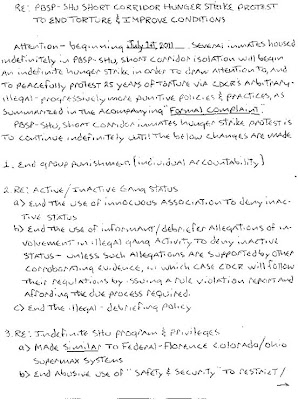
At the request of a prisoner who has been confined for many years in the Security Housing Unit at California's Pelican Bay State Prison, I am attaching a document projecting a hunger strike to begin on or about July 1, 2011.
According to the Complaint, these men are in solitary confinement under harsh conditions due to their "status." They have been labeled gang affiliated, even though they have not been charged or found guilty of a gang related act, based on allegations by confidential inmate informants seeking and receiving special treatment.
In order to be released from the Security Housing Unit they must "debrief." That means providing staff with information implicating others as gang members or associates, adversely impacting the gang to the point where they will never be accepted back. This can cause harm to other prisoners, and make the prisoner who debriefs (or a member of his family) a target for reprisal.
Some of these men are jailhouse lawyers who challenge correctional policies and practices and encourage others to do so.
In a covering letter, I was asked to pass this information on to anyone with possible interest. If you have a newsletter or website, these prisoners would appreciate your posting the attached document. Thank you for whatever you do to alleviate their situation.
A document projecting a hunger strike to begin on or about July 1, 2011 at California's Pelican Bay State Prison: [http://www.indybay.org/uploads/2011/04/03/pelicanbaysmu.pdf]
[http://www.indybay.org/newsitems/2011/04/03/18676255.php]
Dear Friends,
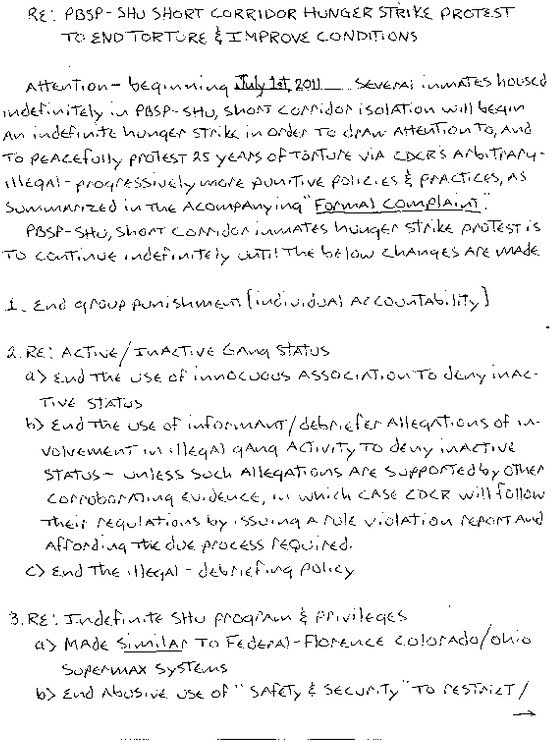
At the request of a prisoner who has been confined for many years in the Security Housing Unit at California's Pelican Bay State Prison, I am attaching a document projecting a hunger strike to begin on or about July 1, 2011.
According to the Complaint, these men are in solitary confinement under harsh conditions due to their "status." They have been labeled gang affiliated, even though they have not been charged or found guilty of a gang related act, based on allegations by confidential inmate informants seeking and receiving special treatment.
In order to be released from the Security Housing Unit they must "debrief." That means providing staff with information implicating others as gang members or associates, adversely impacting the gang to the point where they will never be accepted back. This can cause harm to other prisoners, and make the prisoner who debriefs (or a member of his family) a target for reprisal.
Some of these men are jailhouse lawyers who challenge correctional policies and practices and encourage others to do so.
In a covering letter, I was asked to pass this information on to anyone with possible interest. If you have a newsletter or website, these prisoners would appreciate your posting the attached document. Thank you for whatever you do to alleviate their situation.
A document projecting a hunger strike to begin on or about July 1, 2011 at California's Pelican Bay State Prison: [http://www.indybay.org/uploads/2011/04/03/pelicanbaysmu.pdf]
Subscribe to:
Posts (Atom)